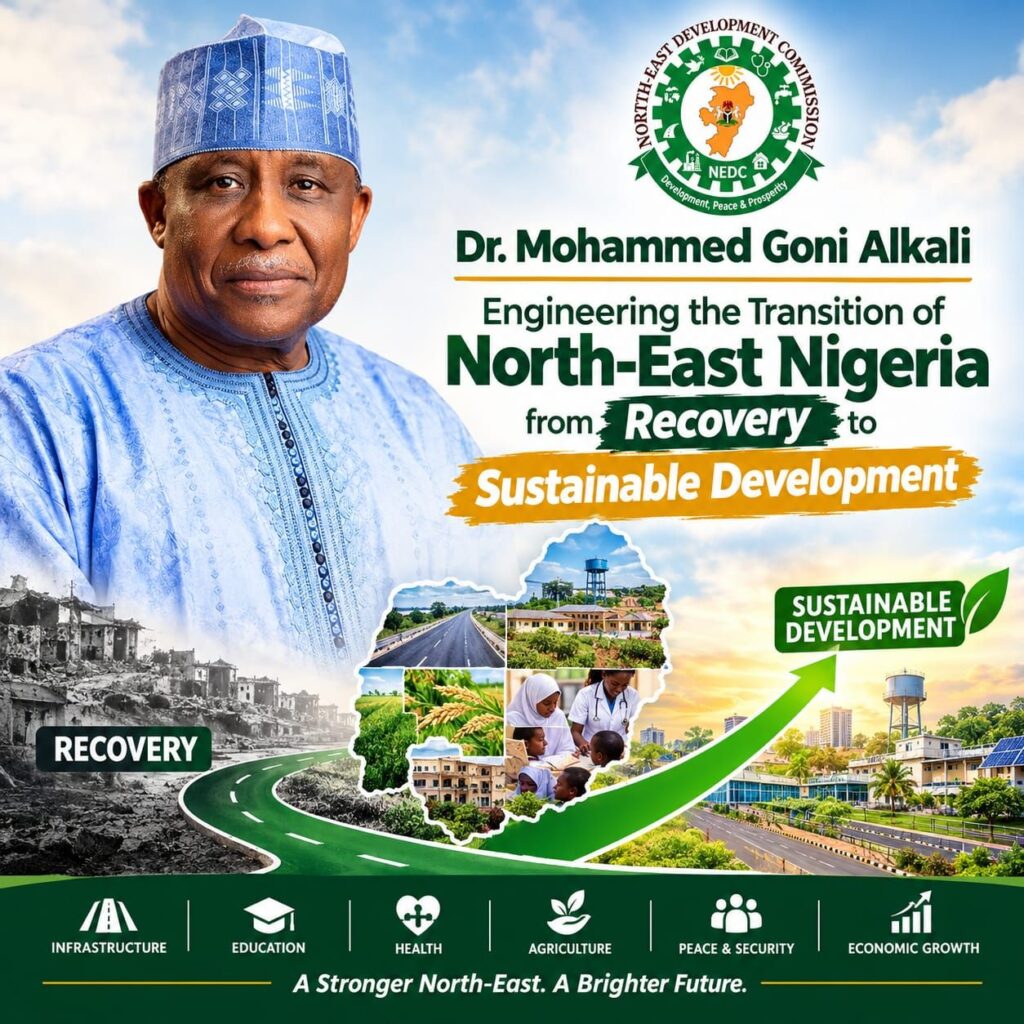
In every society, there are individuals whose relevance to their people is not determined solely by the offices they occupy, the positions they hold or the privileges attached to their status. Rather, their significance is measured by the impact they make, the lives they touch, the relationships they build and their commitment to the welfare and progress of humanity. Dr. Mohammed Goni Alkali, Managing Director and Chief Executive Officer of the North-East Development Commission (NEDC), belongs to this category of public servants.
An accomplished financial expert, administrator, development strategist, philanthropist and bridge builder, Dr. Alkali represents a distinctive blend of professional excellence, public service and personal commitment to humanity. His contributions to the development of Nigeria’s North-East go beyond the responsibilities attached to his position at the Commission. They are reflected in his vision for the region, his approach to leadership, his concern for vulnerable communities and his determination to translate development aspirations into tangible results.
A Leader with a Sense of Responsibility
Leadership comes with expectations, responsibilities and the obligation to make a meaningful difference in the lives of the people one serves. However, the true significance of leadership is not demonstrated by the authority attached to an office but by how that authority is deployed to improve society.
Dr. Mohammed Goni Alkali has consistently demonstrated an understanding of this responsibility through his development-oriented approach to managing the affairs of the NEDC.
Under his leadership, the Commission has continued to pursue interventions across the six states of Adamawa, Bauchi, Borno, Gombe, Taraba and Yobe, with emphasis on infrastructure, education, healthcare, electricity, water supply, human capital development, economic recovery and institutional strengthening.
His leadership philosophy, which places emphasis on action, compassion and purpose, reflects an understanding that the North-East requires more than temporary interventions. It requires sustainable investments capable of restoring livelihoods, strengthening communities and creating opportunities for present and future generations.
His approach also recognises that development must be inclusive, extending beyond major cities to rural communities and populations whose needs are often less visible.
A Brief Account of His Professional and Public Service
Dr. Mohammed Goni Alkali’s professional journey is distinguished by academic excellence, extensive experience in financial management and years of service in the Nigerian banking industry.
He obtained a First-Class degree in Accounting from Bayero University, Kano, in 1983, before proceeding to the London School of Economics and Political Science, University of London, where he obtained a Master’s degree in Accounting and Finance in 1986.
He began his professional career in academia as a lecturer at the University of Maiduguri before transitioning into the banking sector in 1988. Over the course of more than two decades in the industry, he occupied several strategic positions and developed considerable experience in financial administration, enterprise development and institutional management.
His career at the Bank of Industry included serving as General Manager, Large Enterprises, General Manager, Small and Medium Enterprises, and subsequently Executive Director, Operations.
He also chaired the Federal Government’s ₦10 billion Rice Processing Intervention Fund, an initiative associated with efforts to strengthen agricultural processing and stimulate economic development.
These experiences provided him with a strong foundation in financial management, enterprise development and public-sector administration.
His appointment as Managing Director and Chief Executive Officer of the North-East Development Commission brought together these experiences at a critical period in the region’s recovery and development journey.
Since assuming leadership of the Commission, he has continued to advance an institutional development agenda that seeks to move the North-East beyond post-conflict recovery towards sustainable prosperity.
A Philanthropist Beyond Institutional Responsibilities
Perhaps one of the important dimensions of Dr. Mohammed Goni Alkali’s public identity is his disposition towards humanity and his understanding that leadership should be accompanied by compassion and concern for others.
While his official responsibilities at the NEDC demand considerable attention, his personal interactions and gestures of generosity have also contributed to the goodwill he enjoys among people who have encountered him.
His philosophy of giving reflects the traditional understanding that wealth, influence and professional achievements acquire greater meaning when they are used to benefit others.
For Dr. Alkali, the value of philanthropy is not necessarily measured by the publicity surrounding a particular gesture but by the difference such an act makes in someone’s life.
His personal generosity, encouragement and willingness to support people within his sphere of influence have become important aspects of the goodwill associated with his personality.
Indeed, the expression *Khairun Nass Man Yanfa’un Nass* — the best of people are those who are most beneficial to others — captures an important principle of the humanitarian leadership that he represents.
It is a reminder that the essence of leadership should not be confined to official assignments, but should also be reflected in the capacity to inspire, encourage and uplift others.
A Man Whose Thoughts Remain with His People
Although much of Dr. Alkali’s professional life is occupied by national responsibilities, institutional engagements and development assignments, his connection with the North-East remains central to his work.
His position at the NEDC places him at the centre of a development mandate that directly concerns millions of people across the region.
The question that should continually guide any development-oriented leader is simple: What are the needs of the people, what challenges remain unresolved, and what practical interventions can improve their circumstances?
This thinking is reflected in the Commission’s development priorities, which seek to address some of the region’s most pressing challenges.
From roads and bridges to schools, healthcare facilities, electricity, water supply and skills acquisition, the Commission’s interventions demonstrate the importance of connecting development planning with the actual needs of communities.
Beyond physical infrastructure, the human dimension of development remains equally important. Young people need opportunities, women require economic empowerment, communities need functional social amenities, and businesses need an enabling environment to grow.
These are the considerations that make regional development more meaningful than the mere execution of projects.
Consistency: The Hallmark of His Leadership
One of the defining features of Dr. Mohammed Goni Alkali’s leadership at the NEDC is the emphasis on continuity and the pursuit of a broader development vision.
The Commission’s mandate requires long-term planning, institutional consistency and the ability to coordinate interventions across six states with different development priorities and challenges.
Under his leadership, the NEDC has continued to pursue projects and programmes designed to address these challenges.
The Commission’s interventions in road construction, educational infrastructure, healthcare, water supply and electricity access reflect the breadth of its development responsibilities.
Its investment in renewable energy, including the ambitious ₦100 billion solar energy initiative, further demonstrates the importance attached to expanding access to reliable electricity and supporting sustainable economic activities.
Similarly, the Commission’s electric mobility programme, which includes the development of electric vehicle assembly and transit initiatives, represents an effort to introduce new technological and industrial opportunities into the region.
These initiatives reflect a development philosophy that looks beyond immediate challenges and considers the economic possibilities of the future.
Indeed, one could argue that Dr. Alkali’s most significant contribution may ultimately be measured not only by the projects executed during his tenure but also by the institutional structures, development frameworks and opportunities established for generations to come.
A Bridge Builder and a Unifying Personality
The North-East is a region of diverse communities, cultures, political interests, religious identities and development priorities. Advancing its collective interests requires effective collaboration, consultation and the ability to bring different stakeholders together.
As head of the NEDC, Dr. Mohammed Goni Alkali occupies an important position in facilitating this process.
The Commission’s mandate requires engagement with federal and state governments, traditional institutions, development partners, private-sector organisations, civil society groups and communities across the region.
Such responsibilities demand more than administrative competence. They require patience, diplomacy, institutional coordination and the ability to build relationships around common development objectives.
A bridge builder is not simply someone who brings people together at formal meetings. A bridge builder is someone who creates understanding, encourages cooperation, reconciles competing interests and helps different stakeholders recognise their shared responsibilities.
In this regard, the importance of Dr. Alkali’s leadership extends beyond the administration of an intervention agency. It also involves strengthening the relationships and partnerships necessary for sustainable regional development.
His development-oriented approach reinforces the principle that rebuilding the North-East must be a collective responsibility rather than the burden of one institution or government alone.
Beyond Titles and Political Positions
Public offices are temporary. Appointments come and go, and institutional responsibilities eventually pass from one individual to another. However, the impact of responsible leadership, the institutions strengthened, the opportunities created and the lives improved can endure for generations.
Dr. Mohammed Goni Alkali’s professional journey offers an opportunity to appreciate this distinction.
His academic achievements demonstrate a commitment to intellectual development. His years in the banking industry reflect professional discipline and financial expertise. His experience in public-sector administration provides an understanding of institutional responsibilities, while his leadership at the NEDC represents an opportunity to translate these experiences into regional development.
These different dimensions combine to present a personality whose contributions cannot be measured exclusively by the years spent occupying public office.
Ultimately, the worth of a public servant should also be considered through the communities reached, the infrastructure delivered, the opportunities created, the institutions strengthened and the people whose circumstances have improved as a result of purposeful leadership.
A Leader of Action, Compassion and Purpose
There is an important distinction between occupying a leadership position and making leadership meaningful.
Some individuals are remembered primarily for the offices they held, while others are remembered for the impact of their decisions, the opportunities they created and the positive changes associated with their service.
Dr. Mohammed Goni Alkali’s leadership at the NEDC presents an opportunity to examine this distinction.
His development agenda reflects an understanding that the North-East requires a comprehensive approach to recovery and prosperity. It is not enough to reconstruct damaged infrastructure without also rebuilding livelihoods, strengthening institutions, empowering young people and creating sustainable economic opportunities.
The Commission’s development framework, including its strategic focus on moving the region from recovery to prosperity, recognises the interconnected nature of these responsibilities.
This is why investments in education, healthcare, transportation, energy, agriculture, enterprise development and human capital must be viewed as complementary components of a broader regional transformation agenda.
The philosophy of leadership that combines action, compassion and purpose is particularly relevant to a region that continues to confront complex development challenges.
Conclusion: A Legacy of Humanity, Development and Service
There are leaders whose relevance is defined by the positions they occupy, and there are those whose significance is reflected in the lasting impact of their service.
Dr. Mohammed Goni Alkali belongs to a category of public servants whose leadership provides an opportunity to appreciate the relationship between professional excellence, humanitarian values and institutional development.
His journey from academia to the banking industry and ultimately to the leadership of the North-East Development Commission reflects a career shaped by experience, responsibility and service.
Through the NEDC, his leadership is associated with the continuing effort to rebuild communities, expand infrastructure, strengthen human capital and create a more prosperous future for the North-East.
Beyond official responsibilities, his personal disposition towards generosity, compassion, encouragement and the welfare of others adds another dimension to his public identity.
For him, leadership should be about more than occupying an office; it should be about accepting responsibility. Philanthropy should be about more than giving; it should be about making a difference. And development should be about more than constructing projects; it should be about improving human lives.
As the North-East continues its journey from recovery to prosperity, individuals who combine professional competence with compassion, institutional commitment and a genuine appreciation of humanity deserve recognition for their contributions.
Dr. Mohammed Goni Alkali’s story offers an important reminder that the greatest legacy of a leader may not be the office he occupies, but the institutions he strengthens; not the title he carries, but the opportunities he creates; and not merely the projects he commissions, but the lives that are positively transformed through his service.
*Ultimately leadership is not only about what a man becomes; it is about what becomes possible for others because of his leadership.*