
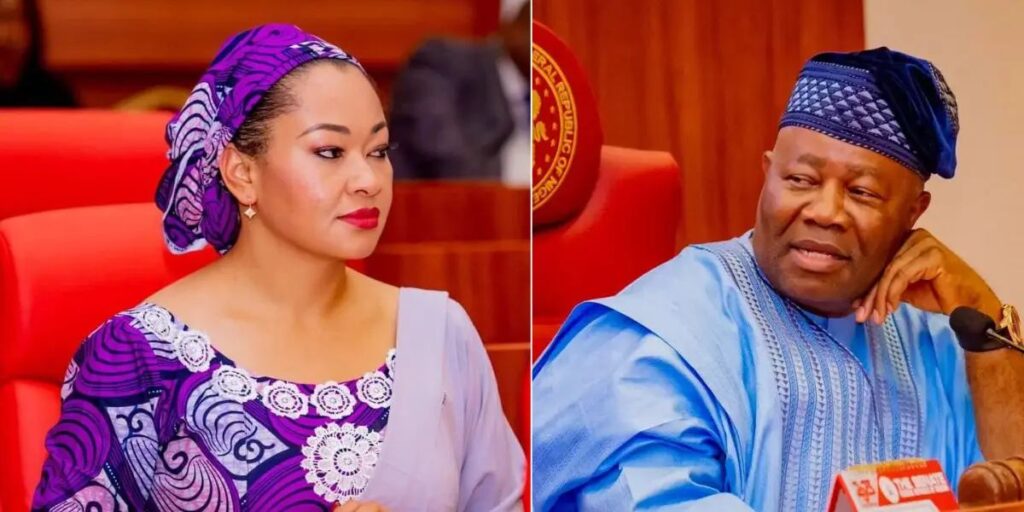
The Special Adviser on Media and Publicity to the Senate President, Mr Eseme Eyiboh, has said that Senate President Godswill Akpabio withdrew all defamation suits filed in his name as an act of faith, leadership responsibility and national reconciliation.
Eyiboh made this known in a statement on Thursday, dismissing claims that the decision was influenced by political pressure or expediency.
According to him, the decision followed deep personal reflection by Akpabio after attending a New Year Mass on Jan. 1 at the Sacred Heart Parish, Uyo, Akwa Ibom State.
He said that during the Mass, the parish priest, Rev. Fr. Donatus Udoette, urged worshippers to forgive past wrongs, let go of grievances and pursue peace.
“Senator Akpabio was not at a political meeting or engaging supporters. He was simply in church as a worshipper when the message of forgiveness resonated deeply with him,” Eyiboh said.
He disclosed that shortly after the service, the Senate President informed those around him of his decision to forgive his critics and withdraw all pending court cases arising from alleged defamatory statements.
Eyiboh said the directive affected about nine defamation suits, including the N200 billion suit against Sen. Natasha Akpoti-Uduaghan and other cases involving individuals and associates.
He emphasised that Akpabio had always defended his reputation through lawful means and had no regrets about approaching the courts when accusations were made against him.
“For him, the law has always served as a legitimate instrument for protection and redress. Choosing to step away from that option now represents a conscious pause from a position of authority he is familiar with,” he said.
Eyiboh described the move as consistent with Akpabio’s leadership philosophy, which blends political authority with strong religious values.
“In his understanding, power is a trust that comes with responsibility. Forgiveness, in that context, is not a sign of weakness but an expression of leadership,” he added.
He noted that prolonged legal disputes often drain leaders emotionally and institutionally, while deepening divisions, stressing that forgiveness allows the Senate President to refocus on pressing national duties.
“There is also a strategic dimension. Promoting reconciliation rather than confrontation helps strengthen unity within the legislature and sustains authority without unnecessary tension,” Eyiboh said.
He dismissed suggestions that the withdrawal of the suits amounted to surrender, saying that restraint requires courage and confidence.
“Absorbing criticism without retaliation is not easy, especially in public office,” he said.
Eyiboh said the action was intended to set a precedent in Nigeria’s political space, where disagreements frequently escalate into personal attacks and legal battles.
“With the country facing insecurity, economic hardship and social mistrust, leaders must show emotional maturity. Such gestures contribute to national healing in ways that policies alone cannot,” he said.
He added that the decision should be seen as a deliberate effort to model forgiveness as both a moral obligation and a leadership principle.
“Sometimes, the boldest political decision is choosing restraint over retaliation,” Eyiboh said.