
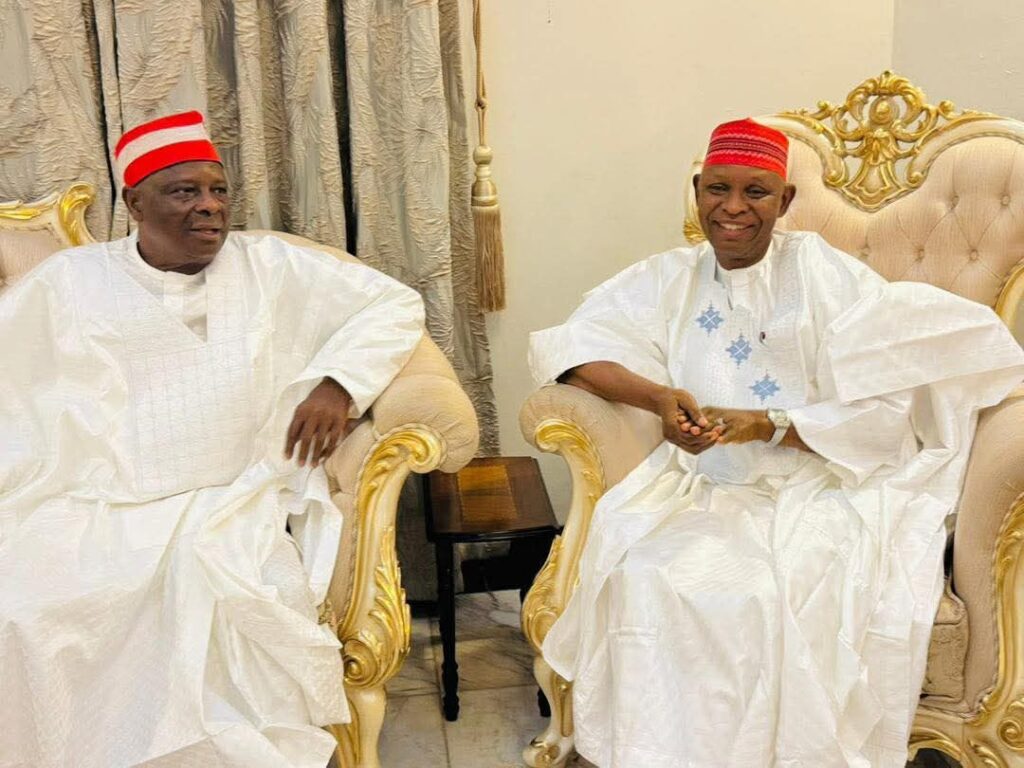
The long-standing phrase in Kano’s political vocabulary — “Siyasar Kano sai Kano” — loosely translated as Kano politics is uniquely Kano, or more pointedly, that it can only be fully understood and navigated by Kano indigenes, has once again resurfaced in national discourse.
Politics in Nigeria’s second most populous state is famously dynamic, fluid and frequently unpredictable. Recent developments have again thrust Kano into the spotlight, as alliances shift swiftly, long-standing rivals explore cooperation and political godfathers drift apart. In the face of seemingly illogical realignments, the popular maxim appears to offer the only plausible explanation.
How else, for instance, can one rationalise reports that Governor Abba Kabir Yusuf — who is currently prosecuting his immediate predecessor, Abdullahi Umar Ganduje, over alleged corruption — is finalising plans for a political alliance with the same man he accused, only days ago, of presiding over monumental governance failures in the state?
Even more striking is the fact that this unfolding alliance appears to coincide with moves by Governor Yusuf to loosen, if not sever, the long-standing political bond tying him to Senator Rabiu Musa Kwankwaso — his mentor of over four decades and Ganduje’s fiercest political adversary.
If Kano politics were not best deciphered by Kano politicians themselves, how does one explain the possibility of Ganduje, Deputy Senate President Barau Jibrin, former Deputy Governor Nasir Yusuf Gawuna and Governor Yusuf — all with deep political histories, competing ambitions and entrenched rivalries — coexisting within the same political fold? More importantly, how would such a grouping produce a consensus governorship candidate and jointly mobilise the state in support of President Bola Ahmed Tinubu’s re-election bid in 2027?
These questions, along with the uncertain political future of Kwankwaso, form the core of the permutations triggered by Governor Yusuf’s possible defection from the New Nigeria People’s Party (NNPP) to the All Progressives Congress (APC).
The already intricate equation, shaped by the Presidency’s sustained effort to court Kwankwaso and the Kwankwasiyya Movement into the APC, became even more complicated when indications emerged that Governor Yusuf had opted to switch parties without the consent or backing of his political benefactor. Sources familiar with the matter say this decision has strained a relationship spanning more than 40 years.
Tinubu’s Strategy for Kano
Multiple reliable sources told Weekend Trust that the Presidency deliberately scaled back its initial aggressive pursuit of Kwankwaso after concluding that Kano could be captured politically without yielding to what insiders described as the Kwankwasiyya leader’s “excessive” demands.
According to these sources, the Presidency became convinced that Kwankwaso’s bargaining power had waned considerably, especially in light of the gradual defection of several key loyalists to the APC.
The argument presented to President Tinubu was anchored on electoral calculations. In the 2023 governorship election, the NNPP, with Yusuf as Kwankwaso’s flagbearer and supported by Senator Kawu Sumaila, Reps Alhassan Ado Rurum, Abdulmumin Jibrin Kofa and Sagir Koki, secured 1,019,602 votes — 51.55 per cent of total votes cast.
By contrast, the APC candidate, Nasir Gawuna, backed by Ganduje and other party heavyweights, polled 890,705 votes, representing 45.03 per cent.
Presidential strategists reasoned that with Sumaila, Rurum, Kofa and Koki already back in the APC — and their political structures largely intact — adding Governor Yusuf, who controls the state’s executive machinery and a significant portion of the Kwankwasiyya grassroots network, would decisively tip the scales in favour of the APC ahead of the 2027 elections.
They also pointed to the 2023 presidential election results as further validation. While Kwankwaso won Kano with 997,279 votes (59.55 per cent), President Tinubu still garnered 517,341 votes — 30.88 per cent — his second-highest vote tally nationwide, despite losing the state.
“The president was persuaded that separating Governor Yusuf from Kwankwaso would work to his advantage,” a senior source told Weekend Trust, speaking anonymously. “It would eliminate the need to remain politically beholden to Kwankwaso or concede excessive ground.
“The numbers support the strategy, though voter behaviour remains unpredictable,” the source added.
If you want a shorter newspaper version, a more analytical tone, or a headline rewrite, I can adapt it further.