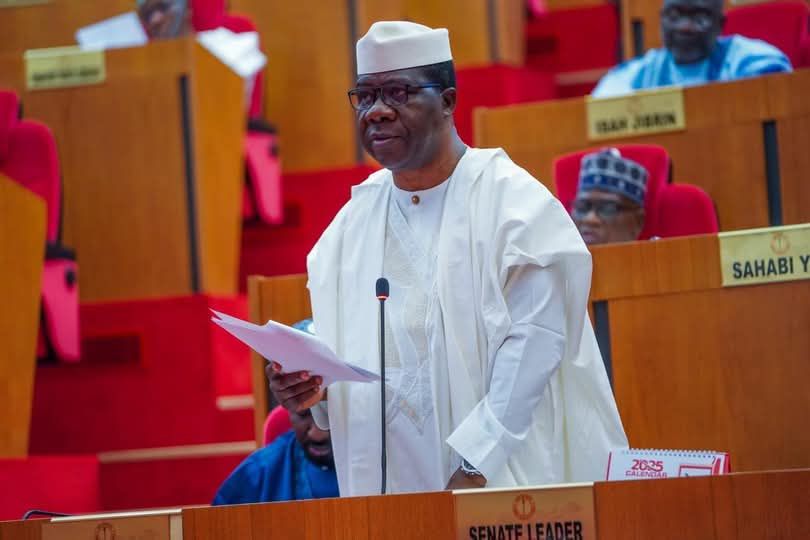
The Senate Leader, Opeyemi Bamidele, has stated that the proposed 2026 Electoral Act will significantly curb the influence of wealthy political actors in Nigeria’s electoral process, particularly during party primaries.
Speaking in a statement released on Easter Sunday through his Directorate of Media and Public Affairs, Bamidele explained that the new electoral framework is designed to strengthen internal democracy by eliminating indirect primaries, which he said have historically enabled manipulation by powerful individuals.
According to him, the revised law restricts the nomination of candidates to either direct primaries or consensus arrangements, a move aimed at giving ordinary party members greater participation in the democratic process.
Direct Primaries to Empower Party Members
Bamidele emphasized that the decision to adopt direct primaries was not arbitrary but the result of extensive consultations with key stakeholders across the political spectrum.
“The provision is intentional and not self-serving,” he said. “It seeks to end a delegate system that has often compromised the will of the majority while empowering moneybags to hijack party primaries.”
He noted that under the new system, all registered party members would have the opportunity to vote for candidates, thereby reducing the influence of a few delegates who could be swayed with financial inducements.
Opposition Raises Concerns
However, opposition parties, particularly the African Democratic Congress (ADC), have criticized certain provisions of the Electoral Act, alleging that they are designed to weaken opposition forces ahead of the 2027 general elections.
Among the contentious provisions is Section 77 (1–7), which mandates political parties to submit a digital register of their members to the Independent National Electoral Commission (INEC).
Additionally, Section 84 (1–3), which limits candidate nomination methods to direct primaries or consensus, has also drawn criticism from opposition groups.
Digital Membership Register for Transparency
Defending the requirement for a digital membership register, Bamidele described it as a global best practice that would enhance transparency and accountability within political parties.
He argued that the measure would prevent external actors or unknown individuals from infiltrating party structures and influencing decisions.
“The register is to ensure that only legitimate members of a political party participate in its internal processes,” he said.
Call for Rule Compliance and National Unity
Bamidele urged political actors to respect the rules governing Nigeria’s electoral system, stressing that adherence to the law is critical for credible elections.
Beyond electoral matters, the Senate Leader also condemned recent violent attacks in Plateau and Kaduna states, calling on Nigerians to embrace peace, tolerance, and sacrifice in line with the values of the Easter season.
Outlook Ahead of 2027 Elections
With the 2027 general elections approaching, the proposed reforms are expected to reshape the internal dynamics of political parties and reduce the role of financial influence in candidate selection.
Analysts believe that if effectively implemented, the shift to direct primaries could deepen democratic participation and restore confidence in Nigeria’s electoral process.