
The contest for the governorship ticket of the All Progressives Congress (APC) in Borno State has entered a critical phase, with high-level negotiations ongoing to reconcile competing interests and produce a consensus candidate ahead of the party’s primaries.
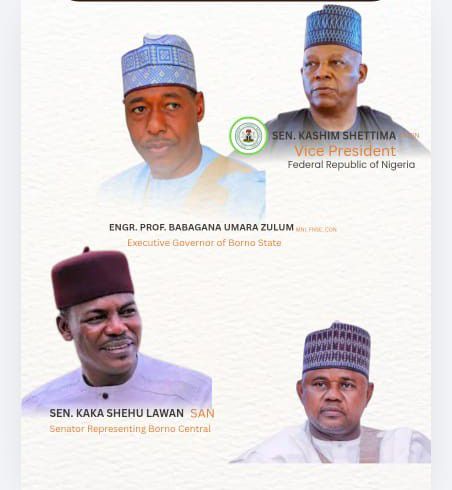
At the center of the unfolding political calculations are two dominant figures: Sen Kaka Shehu Lawan, widely perceived as the preferred candidate of Vice President Kashim Shettima, and Engr Mustapha Gubio, who has been largely regarded as the anointed choice of Governor Babagana Zulum. The alignment of these two influential blocs has shaped the dynamics of the race, making consensus a strategic necessity to avoid internal fractures.
In a development that has further fueled speculation of behind-the-scenes bargaining, Mustapha Gubio, who was scheduled to arrive in Maiduguri at 2:00 pm today to formally present his nomination forms to supporters, postponed his visit for the second time.
Political observers interpret the delay as a calculated move, likely intended to allow room for ongoing negotiations to mature into a unified position before any public show of strength. The postponement underscores the delicate balancing act within the party as leaders work to harmonize interests.
Despite the uncertainty, Gubio’s candidacy continues to gain traction. He has reportedly secured the backing of several Special Advisers to the Governor, while a significant number of local government chairmen are said to be rallying behind him. This growing grassroots and administrative support base suggests that his camp is consolidating influence, potentially strengthening his position at the negotiation table.
On the other hand, Kaka Shehu Lawan remains a formidable contender, buoyed by perceived federal-level backing and longstanding political networks. His candidacy represents continuity of influence from the Vice President’s bloc, adding weight to the push for a balanced outcome that reflects both state and national interests within the APC.
Encouragingly, both camps have publicly signaled their willingness to abide by the outcome of the negotiations, a development that party stakeholders view as crucial for maintaining unity ahead of the general elections. The emphasis on consensus reflects lessons from past intra-party disputes that have, in some instances, weakened electoral prospects.
As consultations continue, attention remains fixed on party elders and key power brokers whose decisions will likely determine the final direction. For many within Borno State, the overriding expectation is that the process will yield a candidate capable of sustaining stability, advancing development, and consolidating the gains recorded in recent years.
With negotiations still in progress, the political landscape remains fluid. The eventual emergence of a consensus candidate, or the decision to proceed to a competitive primary, will not only shape the APC’s fortunes in Borno but also serve as a test of the party’s internal cohesion in one of its stronghold states.