
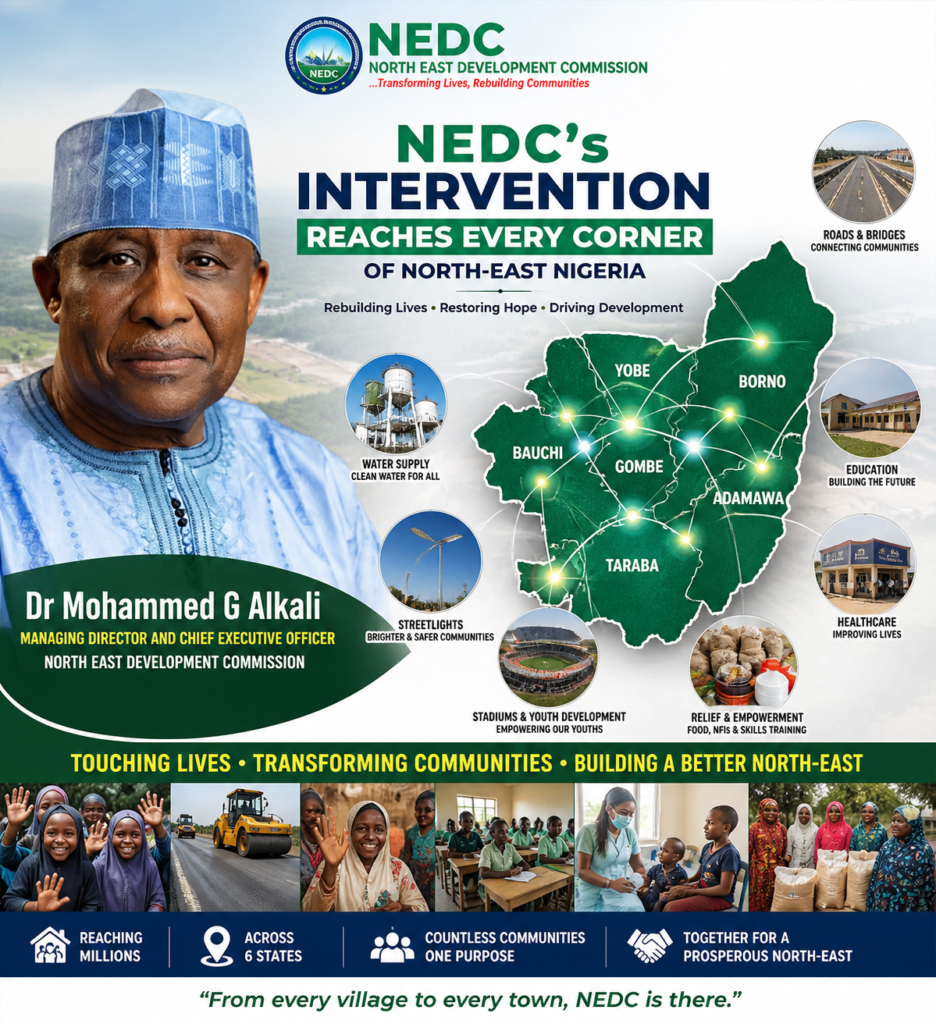
The transformative footprint of the North East Development Commission (NEDC) has become increasingly evident across the six states of the region—Adamawa, Bauchi, Borno, Gombe, Taraba, and Yobe—marking a new chapter of recovery, reconstruction, and sustainable development. Under the leadership of its Managing Director and Chief Executive Officer, Dr Mohammed G Alkali, the Commission has implemented far-reaching interventions that have directly and indirectly impacted millions of lives.
From urban centers to remote rural settlements, NEDC’s presence is visible in virtually every community. Its programs have cut across critical sectors, reflecting a holistic approach to rebuilding the North-East after years of insurgency and infrastructural decay. Through strategic appointments and inclusive governance, the Commission has ensured representation and participation of diverse stakeholders, fostering a sense of ownership among the people.
In the area of infrastructure, the Commission has undertaken the construction and rehabilitation of roads and bridges, easing transportation challenges and boosting economic activities. The installation of solar-powered streetlights has improved security and enhanced night-time commercial operations in many towns and villages. Major projects such as stadium development and urban renewal initiatives further underscore NEDC’s commitment to restoring both social and economic life in the region.
Access to clean water and healthcare has also seen significant improvement. Boreholes and water supply schemes have been deployed in underserved communities, while health interventions—ranging from the construction of primary healthcare centers to the provision of medical supplies—have strengthened the region’s capacity to respond to public health needs.
Education and human capital development remain central to NEDC’s mission. The Commission has invested heavily in the training and retraining of teachers, provision of scholarships for students at various levels, and the rehabilitation of schools destroyed by conflict. These efforts are aimed at rebuilding the intellectual foundation of the region and empowering the next generation.
Equally impactful is NEDC’s humanitarian support. The distribution of food and non-food items has provided relief to vulnerable populations, particularly internally displaced persons (IDPs) and low-income households. Skills acquisition programs and vocational training initiatives have further equipped youths and women with tools for self-reliance and economic independence.
Testimonies from beneficiaries reinforce the widespread impact of these interventions. Ibrahim Musa Mustapha, a resident of the region, confirmed that the Commission’s efforts have touched nearly every household. He noted that he and several members of his family have directly benefited from various NEDC programs, describing the Commission’s work as both inclusive and transformative.