
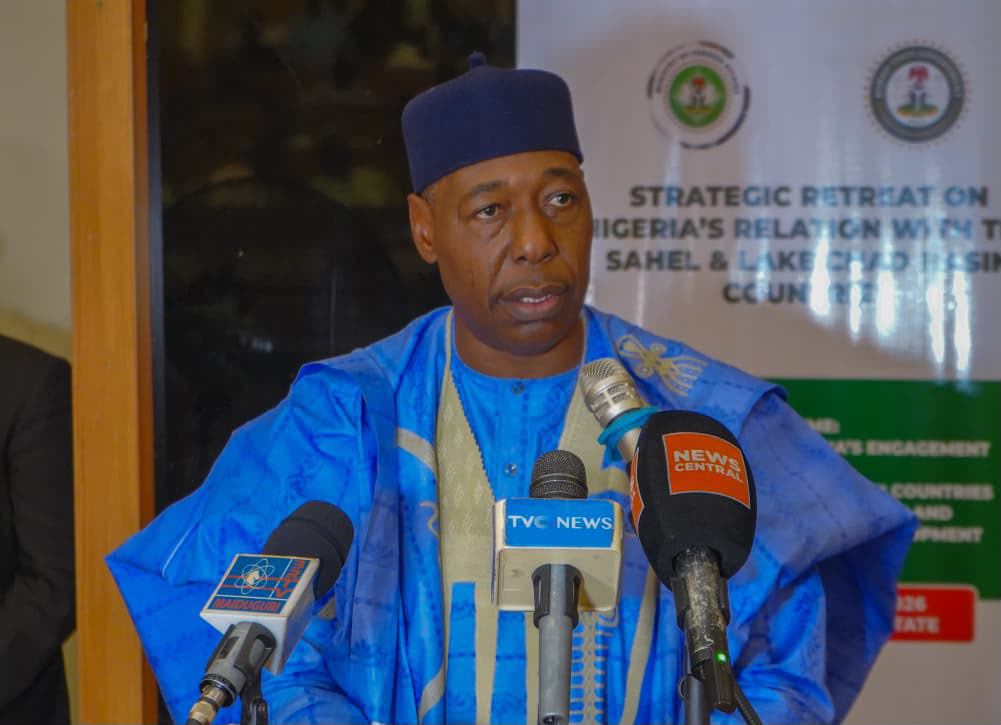
The search for a more coordinated response to terrorism and insecurity in the Sahel received renewed attention on Saturday as Borno State Governor, Prof. Babagana Umara Zulum, hosted a high-level regional retreat in Maiduguri, bringing together representatives of Sahel countries and members of the diplomatic community.
The meeting, held at the conference hall of the Musa Usman Secretariat, provided an important platform for discussions on terrorism, insurgency, border security, intelligence sharing, displacement and the wider development challenges affecting communities across the region.
The gathering also highlighted the growing importance of Maiduguri as a centre for conversations on security and stabilisation in the Lake Chad Basin and the wider Sahel.
A Regional Security Challenge
The security challenges confronting the Sahel have increasingly demonstrated that instability in one country can have consequences far beyond its borders.
Armed groups operating around the Lake Chad Basin and other parts of the Sahel have historically taken advantage of difficult terrain, porous borders, weak economic opportunities and limited state presence in some communities.
For countries sharing borders and historical ties, this creates a complex security environment in which military operations in one location can influence the movement and activities of armed groups elsewhere.
Borno has experienced the consequences of this regional security challenge more directly than many other parts of Nigeria. Since the Boko Haram insurgency intensified, communities across the state have faced attacks, displacement, destruction of infrastructure and disruption of economic activities.
The experience has strengthened calls for a broader strategy that goes beyond military operations.
Zulum Advocates a Comprehensive Approach
Governor Zulum used the retreat to emphasise the importance of combining military action with non-kinetic measures aimed at addressing the conditions that allow violent extremism to persist.
According to the governor, armed forces remain essential to protecting communities and defeating terrorist organisations, but military operations alone cannot permanently resolve the underlying problems.
He advocated stronger intelligence cooperation, improved community-based border management and joint stabilisation programmes involving countries and institutions operating around the Lake Chad Basin.
“While our armed forces continue their brave operations, we must enhance intelligence sharing, community-based border management, and joint stabilisation initiatives alongside the Multinational Joint Task Force,” Zulum said.
The position reflects an increasingly important understanding of modern counter-insurgency efforts: security operations must be accompanied by measures that restore public confidence, rebuild damaged communities and create legitimate economic opportunities.
Why Intelligence Sharing Matters
One of the central issues in combating transnational terrorism is the movement of information between countries.
Terrorist organisations and criminal networks do not necessarily operate within the boundaries of a single country. Fighters, weapons, financing networks and logistical support can move across borders, making isolated national responses less effective.
Improved intelligence sharing can therefore help security agencies identify emerging threats earlier, understand patterns of movement and coordinate responses.
However, intelligence cooperation requires trust, effective communication channels and mechanisms that allow relevant information to reach operational units quickly.
Regional stakeholders therefore face the challenge of transforming political commitments into practical systems of cooperation.
The Importance of Border Communities
Border management was another important dimension of the discussions.
Many communities around the Lake Chad Basin have maintained social, cultural and commercial relationships for generations. National boundaries drawn across these communities do not necessarily correspond with traditional patterns of movement.
This creates a difficult balance for governments.
On one hand, authorities need effective border controls to prevent terrorists and criminal groups from exploiting weak points. On the other hand, excessive restrictions can disrupt legitimate trade, farming, fishing and family relationships that sustain border communities.
A community-based approach could help address both concerns by involving local leaders, residents and relevant government institutions in security and border-management strategies.
Foreign Affairs Ministry Calls for Stronger Cooperation
Speaking at the retreat, the Minister of State for Foreign Affairs, Sola Enikanolaiye, called for stronger regional cooperation in addressing terrorism and insecurity across the Sahel.
He emphasised the importance of addressing the underlying causes of insecurity rather than focusing exclusively on the symptoms.
This perspective is significant because insecurity is often connected to several socioeconomic challenges, including unemployment, poverty, limited access to education, weak public services and the vulnerability of communities affected by prolonged conflict.
Addressing these issues does not replace security operations. Instead, development interventions can complement security efforts by helping communities recover and reducing the conditions that extremist groups may exploit.
Nigeria’s Strategic Interest in Sahel Stability
The Permanent Secretary of the Ministry of Foreign Affairs, Dunoma Umara, also highlighted the historical, cultural and economic connections between Nigeria and countries across the Sahel.
For Nigeria, stability in neighbouring countries has direct implications for national security.
The movement of people and goods across borders means that insecurity in the wider region can affect Nigerian communities, trade routes, humanitarian activities and investment.
A stable Sahel can also create greater opportunities for legitimate commerce and regional economic integration.
Consequently, Nigeria’s interest in regional stability extends beyond counter-terrorism. It includes economic cooperation, infrastructure development, trade, migration management and humanitarian assistance.
Chad Calls for a Common Security Front
The Ambassador of Chad to Nigeria, Brah Mahamat, called for collective action against insecurity in the region.
He argued that differences between regional institutional groupings should not prevent countries from cooperating on shared security challenges.
The ambassador noted that armed groups are not constrained by political or institutional boundaries and can exploit gaps between countries.
His intervention reflects one of the major difficulties facing regional counter-terrorism efforts: the need to maintain effective security cooperation despite differences in political structures and regional alliances.
For communities affected by terrorism, the priority is often straightforward — safe communities, functioning schools, accessible healthcare, opportunities for livelihoods and the freedom to move and conduct legitimate economic activities.
From Military Recovery to Long-Term Stabilisation
Borno’s experience also demonstrates that defeating an insurgency requires more than reclaiming territory.
Once communities are liberated from terrorist control, governments face the difficult task of rebuilding homes, schools, hospitals, roads, markets and other essential infrastructure.
Displaced populations must also be supported as they return to their communities.
This makes stabilisation a long-term process involving security agencies, governments, humanitarian organisations, development partners and local communities.
The success of such efforts can ultimately be measured not only by the reduction in attacks but also by whether residents can return to productive and dignified lives.
The Human Cost of Prolonged Insecurity
Behind the security statistics are millions of people whose lives have been affected by years of conflict.
Families have been displaced, businesses disrupted and educational opportunities interrupted. Farmers and traders have also faced difficulties accessing their fields and markets in areas affected by insecurity.
Children are particularly vulnerable to the consequences of prolonged conflict because interruptions to education can have effects that last for years.
For this reason, regional security discussions must maintain a strong humanitarian and development dimension.
Protecting civilians should remain central to every counter-insurgency strategy.
Economic Development as a Security Tool
Economic opportunity is another important component of long-term stabilisation.
When communities regain access to markets, agricultural land, roads, electricity, schools and financial services, residents have greater opportunities to rebuild their livelihoods.
Economic recovery can also strengthen the relationship between citizens and government institutions.
In conflict-affected areas, visible improvements in public services can demonstrate that peaceful communities can benefit from stability.
This is why security and development should not be treated as competing priorities. They are complementary elements of sustainable peace.
The Role of the Multinational Joint Task Force
The Multinational Joint Task Force remains an important platform for cooperation among countries around the Lake Chad Basin.
Its significance lies in the recognition that the security challenge is regional and therefore requires coordinated responses.
However, military cooperation needs to be supported by other forms of collaboration, including intelligence exchange, humanitarian coordination, border management, community engagement and economic recovery programmes.
A stronger regional framework could help reduce the gaps that terrorist groups attempt to exploit.
Maiduguri’s Emerging Regional Role
Hosting the retreat in Maiduguri carries symbolic and practical significance.
As the capital of Borno State, Maiduguri has been at the centre of Nigeria’s experience with the Boko Haram insurgency.
The city has also witnessed substantial humanitarian, security and development interventions over the years.
Holding a high-level regional discussion there provides an opportunity for policymakers and diplomats to engage with a location that has experienced the consequences of insecurity firsthand.
Maiduguri’s emergence as a venue for regional dialogue could also contribute to changing perceptions of the city — from being known primarily as a conflict-affected location to becoming a centre for conversations about recovery, resilience and regional cooperation.
A Broader Vision for the Sahel
The discussions in Maiduguri point to a wider lesson for the region: sustainable security cannot depend on military strength alone.
Effective counter-terrorism requires capable security institutions, reliable intelligence, secure borders and regional coordination.
At the same time, governments must invest in education, healthcare, agriculture, infrastructure, youth employment and local economic development.
Communities must also be given meaningful roles in stabilisation efforts because local residents often possess valuable knowledge about their environment and emerging security threats.
The challenge is therefore not simply how to defeat terrorist groups militarily, but how to create conditions in which violent extremist organisations find it increasingly difficult to recruit, operate and gain influence.
The Road Ahead
The Maiduguri retreat offers an opportunity for regional stakeholders to move from dialogue to practical action.
Future cooperation could focus on strengthening intelligence-sharing mechanisms, improving border coordination, supporting affected communities and expanding joint stabilisation programmes.
There is also a need for stronger coordination between security and civilian institutions so that military gains can be converted into sustainable peace and development.
For Nigeria and its Sahelian neighbours, the stakes are considerable.
A more secure region would provide a stronger foundation for investment, trade, agriculture, education and human development. Conversely, continued instability could deepen humanitarian needs and undermine economic progress.
Governor Zulum’s decision to bring regional stakeholders together in Maiduguri therefore underscores an important message: the security challenges confronting the Sahel are interconnected, and their solutions must also be interconnected.
The fight against Boko Haram, ISWAP and other armed groups will require sustained security operations. But lasting peace will ultimately depend on the ability of governments and regional partners to combine security with good governance, economic opportunity, community resilience and human development.
For the people of Borno and communities across the Lake Chad Basin, the goal is not merely to survive conflict. It is to build a future in which families can live safely, children can attend school, businesses can grow and communities can once again realise their full economic potential.