
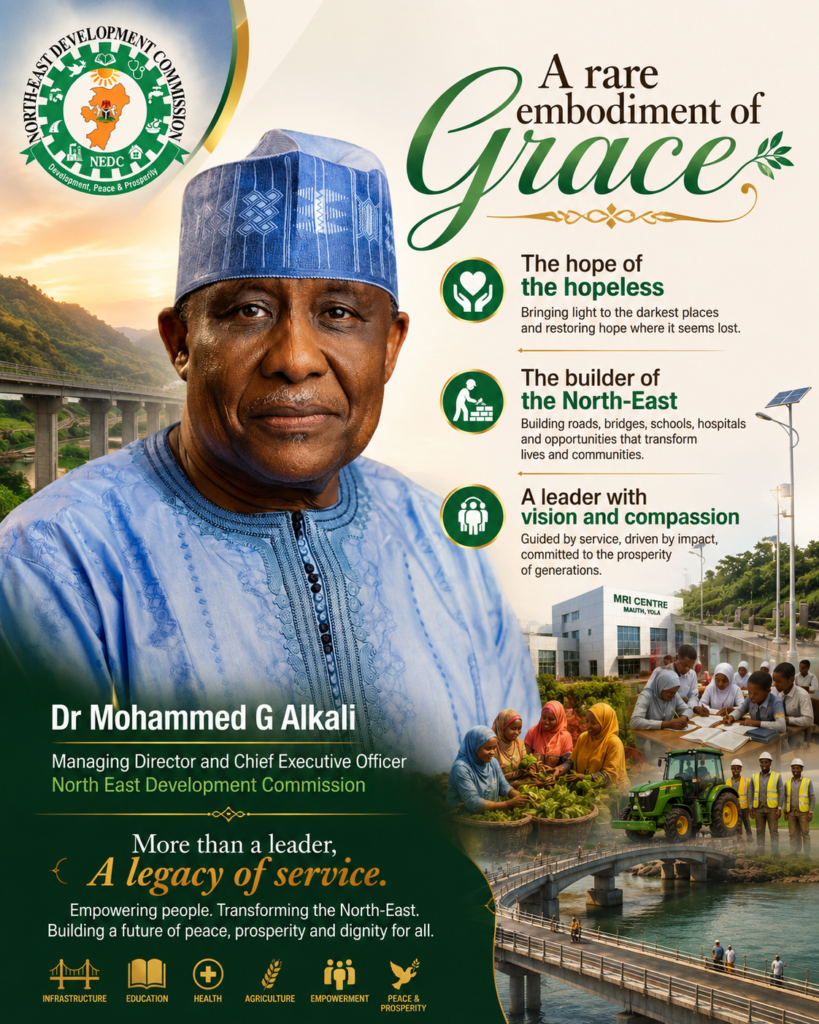
The story of the North-East Development Commission (NEDC) under the leadership of Dr. Mohammed G. Alkali, Managing Director and Chief Executive Officer, is increasingly becoming a story of renewed hope, purposeful development and a determined transition from recovery to prosperity.
In a region that has endured years of insecurity, displacement, destruction of infrastructure, economic disruption and humanitarian challenges, rebuilding requires more than financial resources. It requires vision, compassion, strategic leadership and an unwavering commitment to the people.
It is within this challenging environment that Dr. Alkali has continued to provide leadership aimed at transforming the North-East from a region defined by the scars of conflict into one increasingly defined by resilience, opportunity, development and hope.
He can aptly be described in four powerful expressions:
A rare embodiment of grace.
The hope of the hopeless.
The builder of the North-East.
A leader with vision and compassion.
These descriptions capture a leadership philosophy that places people at the centre of development while pursuing the broader objective of building a stronger, more prosperous and sustainable North-East.
A Rare Embodiment of Grace
Leadership is not measured solely by position or authority. Its true value is reflected in the lives touched, communities transformed and opportunities created.
To describe Dr. Mohammed G. Alkali as a rare embodiment of grace is to recognise a leadership disposition anchored in service, humility and responsibility.
At the helm of an institution with an enormous mandate, his leadership has been associated with an approach that recognises that development is ultimately about people.
Behind every road is a farmer trying to reach a market.
Behind every bridge is a community seeking connection.
Behind every school is a child preparing for the future.
Behind every healthcare facility is a family seeking hope.
Behind every empowerment programme is an individual seeking dignity and economic independence.
This people-centred understanding of development gives greater meaning to the work of the NEDC.
The philosophy of Khairun Nass Man Yanfa’un Nass.
“The best of people are those who benefit others”, provides a fitting description of leadership that seeks to make public service meaningful through tangible benefits to society.
For Dr. Alkali, development is therefore not merely about constructing physical assets. It is about creating an environment where people can regain confidence, rebuild their livelihoods and believe once again in the possibilities of tomorrow.
The Hope of the Hopeless
For many communities across the North-East, the consequences of prolonged conflict went far beyond the destruction of buildings and infrastructure.
Families lost livelihoods. Communities were displaced. Businesses were disrupted. Educational opportunities were interrupted.
Healthcare systems faced enormous pressures, while young people confronted limited opportunities.
In such circumstances, development becomes an instrument of hope.
A new road tells a community that it has not been forgotten.
A reconstructed bridge restores connectivity.
A modern healthcare facility tells families that their health and dignity matter.
An educational facility gives young people the opportunity to prepare for a better future.
Agricultural support gives farmers the means to produce and earn.
Entrepreneurship programmes give young people an alternative pathway to economic independence.
Renewable-energy investments can provide the power required for businesses, schools, healthcare facilities and communities to function more effectively.
This is why the NEDC’s intervention under Dr. Alkali carries significance beyond the physical projects themselves.
It represents the restoration of confidence, dignity and possibility.
The hope of the hopeless is not simply the provision of assistance. It is the creation of conditions that allow people to become productive participants in their own development.
The Builder of the North-East
The description of Dr. Mohammed G. Alkali as “the builder of the North-East” reflects the breadth of the development responsibilities entrusted to the NEDC.
Building the North-East is not a single project.
It is a comprehensive undertaking involving infrastructure, education, healthcare, agriculture, energy, enterprise, human capital, transportation, environmental sustainability and economic development.
The task is also more complex than simply replacing what was destroyed.
The real challenge is to build better, build sustainably and build for the future.
Under Dr. Alkali’s leadership, the NEDC’s development agenda is increasingly associated with projects and interventions designed to strengthen the foundations upon which long-term regional prosperity can be built.
Roads and bridges improve mobility and economic connectivity.
Schools and student accommodation strengthen human capital.
Healthcare investments improve access to essential and specialised services.
Agricultural interventions support farmers and strengthen food production.
Entrepreneurship and MSME initiatives create pathways to employment and wealth creation.
Energy investments address one of the fundamental constraints to industrial and economic development.
Each intervention contributes a piece to the larger development picture.
The objective is ultimately to create a North-East where communities are connected, businesses can thrive, young people can pursue meaningful opportunities and families can look towards the future with greater confidence.
From Recovery to Prosperity
The North-East’s development journey has entered a stage where recovery alone is no longer sufficient.
Recovery is about rebuilding what was lost.
Development is about creating what is needed.
Prosperity is about creating an economy and society capable of sustaining progress for generations.
This transition represents one of the most important dimensions of the NEDC’s mandate.
The region must move from emergency responses towards long-term economic transformation.
It must move from dependence towards productivity.
It must move from reconstruction towards innovation.
It must move from vulnerability towards resilience.
And it must move from merely surviving the consequences of its past towards actively creating its future.
Dr. Alkali’s leadership is situated within this broader transformation.
The NEDC’s interventions are therefore not simply individual projects scattered across six states. Collectively, they form part of a larger effort to strengthen the economic and social foundations of the region.
The ultimate goal is a North-East where development becomes self-sustaining and where citizens are empowered to become drivers of economic growth.
A Leader with Vision and Compassion
Vision without compassion can produce development that leaves people behind.
Compassion without vision can produce interventions without lasting impact.
The North-East requires both.
Vision is necessary to see what the region can become.
Compassion is necessary to understand the challenges faced by the people.
Strategy is necessary to translate ambition into programmes.
Institutional leadership is necessary to sustain implementation.
This combination is central to the demands placed upon the leadership of the NEDC.
Dr. Alkali’s leadership can therefore be viewed through the balance between strategic development and human impact.
The objective is not simply to build infrastructure, but to ensure that infrastructure improves lives.
It is not simply to support agriculture, but to strengthen agricultural value chains and livelihoods.
It is not simply to build schools, but to invest in a generation capable of driving the region’s future.
It is not simply to provide healthcare infrastructure, but to strengthen the wellbeing and productivity of citizens.
It is not simply to support entrepreneurs, but to create an environment in which businesses can survive, expand and employ others.
That is the difference between construction and transformation.
Building Human Capital, Not Just Physical Structures
One of the most important aspects of sustainable development is human capital.
No region can achieve lasting prosperity if its people are not equipped with the knowledge, skills, health and opportunities required to participate in economic development.
This makes investments in education, healthcare, youth development, skills acquisition and entrepreneurship particularly important.
The North-East possesses a large and youthful population. With appropriate investment, this demographic strength can become one of the region’s greatest economic assets.
Young people can become entrepreneurs, engineers, farmers, healthcare professionals, educators, technology specialists and industrial workers.
Women can become stronger participants in agriculture, enterprise and community development.
Students can acquire the knowledge needed to solve regional challenges.
Farmers can transition from subsistence production to commercial agriculture.
Businesses can grow from small enterprises into employers of labour.
This is the human dimension of the transformation agenda.
A Legacy of Service and Impact
The most enduring legacy of a public leader is rarely found in titles.
It is found in the memories of communities.
It is found in the child who gains access to education.
The patient who receives treatment.
The farmer who reaches the market.
The entrepreneur who employs another young person.
The family whose community is reconnected by a bridge.
The student who finds accommodation close to an institution of learning.
The young person who acquires a skill and discovers a pathway to economic independence.
These are the quiet but profound measures of development.
They demonstrate that public institutions can make a difference in the everyday lives of citizens.
And they reinforce the idea that development is ultimately about people before projects, impact before statistics and transformation before recognition.
A North-East of Peace, Progress and Prosperity
The vision for the North-East must ultimately extend beyond recovery.
The region has the potential to become an important centre of agriculture, commerce, manufacturing, technology, renewable energy and human capital development.
Its enormous agricultural potential, strategic location, youthful population and rich cultural heritage provide foundations upon which a prosperous future can be built.
But potential requires purposeful leadership.
It requires infrastructure.
It requires investment.
It requires security.
It requires education.
It requires healthcare.
It requires entrepreneurship.
It requires energy.
And, above all, it requires institutions capable of sustaining a long-term development vision.
This is where the NEDC’s role becomes particularly significant.
Under Dr. Mohammed G. Alkali, the Commission is positioned not merely as an institution responding to the consequences of crisis, but as an important instrument for building the economic and social foundations of the North-East’s future.
In Conclusion,
Dr. Mohammed G. Alkali’s leadership at the North East Development Commission represents a chapter in the continuing transformation of a region that has endured extraordinary challenges.
His leadership can be celebrated as a rare embodiment of grace, reflecting service and humanity; the hope of the hopeless, restoring confidence and opportunity; the builder of the North-East, advancing infrastructure and human development; and a leader with vision and compassion, combining strategic ambition with concern for the people.
The journey ahead remains substantial. But the North-East is no longer defined solely by the challenges of its past.
It is increasingly being defined by what it is building for the future.
From roads and bridges to schools and hospitals, from agriculture to entrepreneurship, from energy to human capital, the foundation for a new North-East is being strengthened.
The destination is clear:
From recovery to renewal.
From renewal to growth.
From growth to prosperity.
And at the heart of this journey is a simple philosophy of service:
“Khairun Nass Man Yanfa’un Nass”.
The best of people are those who benefit others.
Dr. Mohammed G. Alkali, a rare embodiment of grace, a source of hope, a builder of the North-East, and a leader committed to moving the region towards a future of peace, progress and shared prosperity.