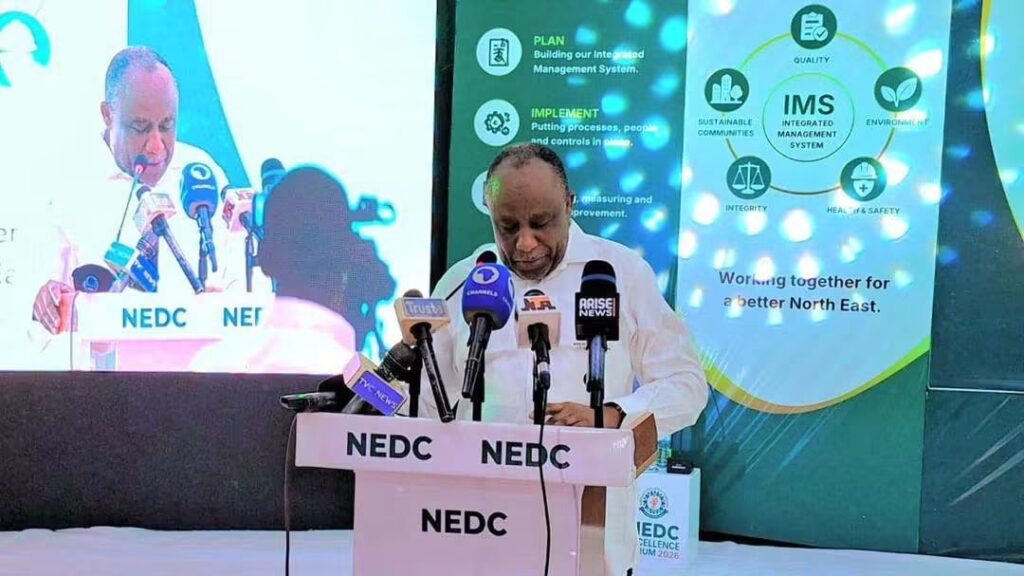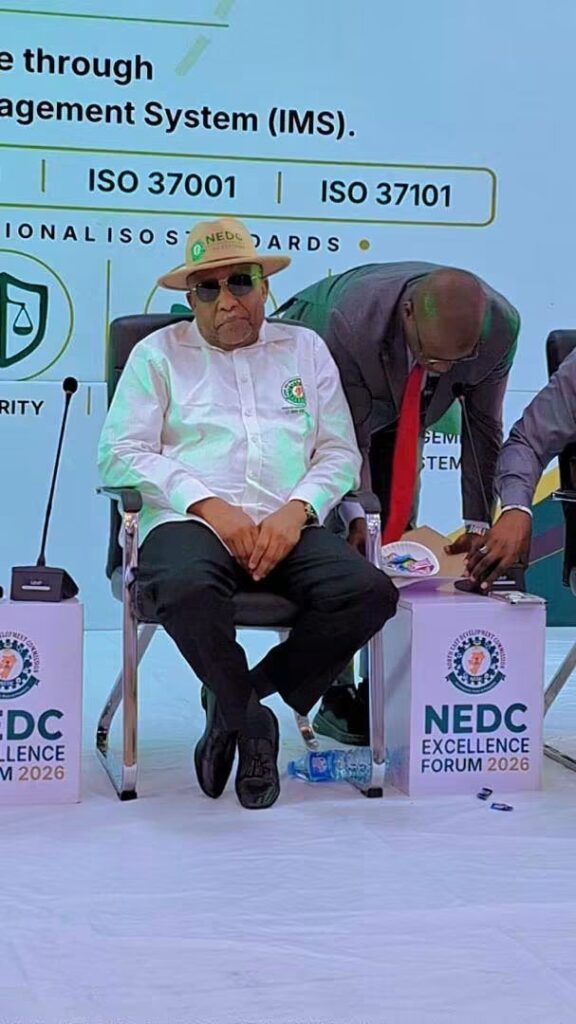
The North East Development Commission (NEDC) has commenced its 2026 Excellence Forum in Maiduguri, Borno State, with a renewed emphasis on strengthening institutional capacity, improving internal processes and embedding a culture of quality, accountability, integrity and continuous improvement across the Commission.
The three-day forum, which runs from September 14 to 16 at the Borno State Hotel, brings together staff from NEDC’s headquarters and its various State Offices for intensive engagements aimed at translating internationally recognised management standards into practical workplace outcomes.
The forum comes against the backdrop of NEDC’s certification to five International Organization for Standardization (ISO) management system standards, reinforcing the Commission’s efforts to establish robust institutional systems for delivering development interventions across the six states of the North-East.
The five standards are ISO 9001 on Quality Management, ISO 14001 on Environmental Management, ISO 45001 on Occupational Health and Safety Management, ISO 37001 on Anti-Bribery Management, and ISO 37101 on Sustainable Development in Communities.
Rather than treating the certifications as mere institutional milestones, the Commission is seeking to ensure that the principles embedded in the standards become part of its everyday operations, decision-making processes and service delivery culture.
Speaking on the significance of the Excellence Forum, NEDC Managing Director and Chief Executive Officer, Dr Mohammed Goni Alkali, stressed that the true value of the ISO certifications would ultimately be determined by their impact on the way the Commission works and delivers for the people of the North-East.
According to him, obtaining international certifications is only one part of the journey, while the more important task is to ensure that the standards are understood, internalised and consistently applied by personnel across the organisation.
He said the Commission was therefore moving from “standards to practice”, with greater emphasis on improving processes, strengthening teamwork, promoting accountability and ensuring that institutional systems translate into better development outcomes.
The approach is designed to ensure that quality management goes beyond documentation and compliance to become an integral part of project planning, implementation, monitoring and evaluation.
The forum also provides an opportunity for NEDC personnel to examine how their individual responsibilities contribute to the Commission’s wider mandate and how stronger collaboration among departments and State Offices can improve the efficiency and effectiveness of development interventions.
Unlike conventional workshops that are primarily lecture-based, the 2026 Excellence Forum is structured around practical exercises, simulations, collaborative problem-solving and workplace scenarios.
Through these activities, participants are being encouraged to identify institutional challenges, examine existing processes and develop practical approaches for improving performance.
The focus on practical application is particularly significant for an organisation with a broad development mandate covering infrastructure, education, healthcare, agriculture, enterprise development, environmental management and other interventions aimed at rebuilding and accelerating socio-economic development in the North-East.
The ISO 9001 certification, for instance, provides a framework for consistently improving the quality of organisational processes and services, while ISO 14001 strengthens attention to environmental management.
Similarly, ISO 45001 focuses on occupational health and safety, ISO 37001 provides a framework for preventing and addressing bribery, and ISO 37101 supports sustainable development within communities.
Taken together, the five standards provide an institutional framework intended to promote quality, integrity, sustainability, safety and responsible development.
For NEDC, the Excellence Forum therefore represents an effort to connect these principles to the Commission’s day-to-day responsibilities.
The initiative also reflects the growing recognition that sustainable development is not solely dependent on the volume of projects delivered but equally on the strength of the institution responsible for planning, implementing, supervising and sustaining those interventions.
A strong institutional culture, effective internal controls, competent personnel and efficient processes are essential to ensuring that development investments achieve their intended impact.
By bringing together personnel from the headquarters and State Offices, the forum is also expected to strengthen a common understanding of NEDC’s institutional values and create greater consistency in the application of its management systems across the region.
The emphasis on collaboration is particularly important given the geographical spread of NEDC’s operations across Adamawa, Bauchi, Borno, Gombe, Taraba and Yobe States.
With development interventions being implemented across diverse communities and sectors, the ability of staff to work collaboratively, share knowledge and apply consistent standards is critical to effective delivery.
The 2026 Excellence Forum consequently forms part of a broader institutional development agenda aimed at ensuring that NEDC evolves alongside the expanding expectations placed on the Commission.
For the North-East, where development challenges require sustained interventions and coordinated action, strengthening the institution behind the interventions is as important as the projects themselves.
The Commission’s current emphasis is therefore not simply on having internationally recognised certifications, but on ensuring that the principles behind those certifications influence behaviour, processes and outcomes.
Ultimately, the message from the 2026 Excellence Forum is clear: NEDC is moving from standards to practice, strengthening the institution, improving the way it works and building a stronger foundation for delivering sustainable development outcomes to the people of the North-East.