
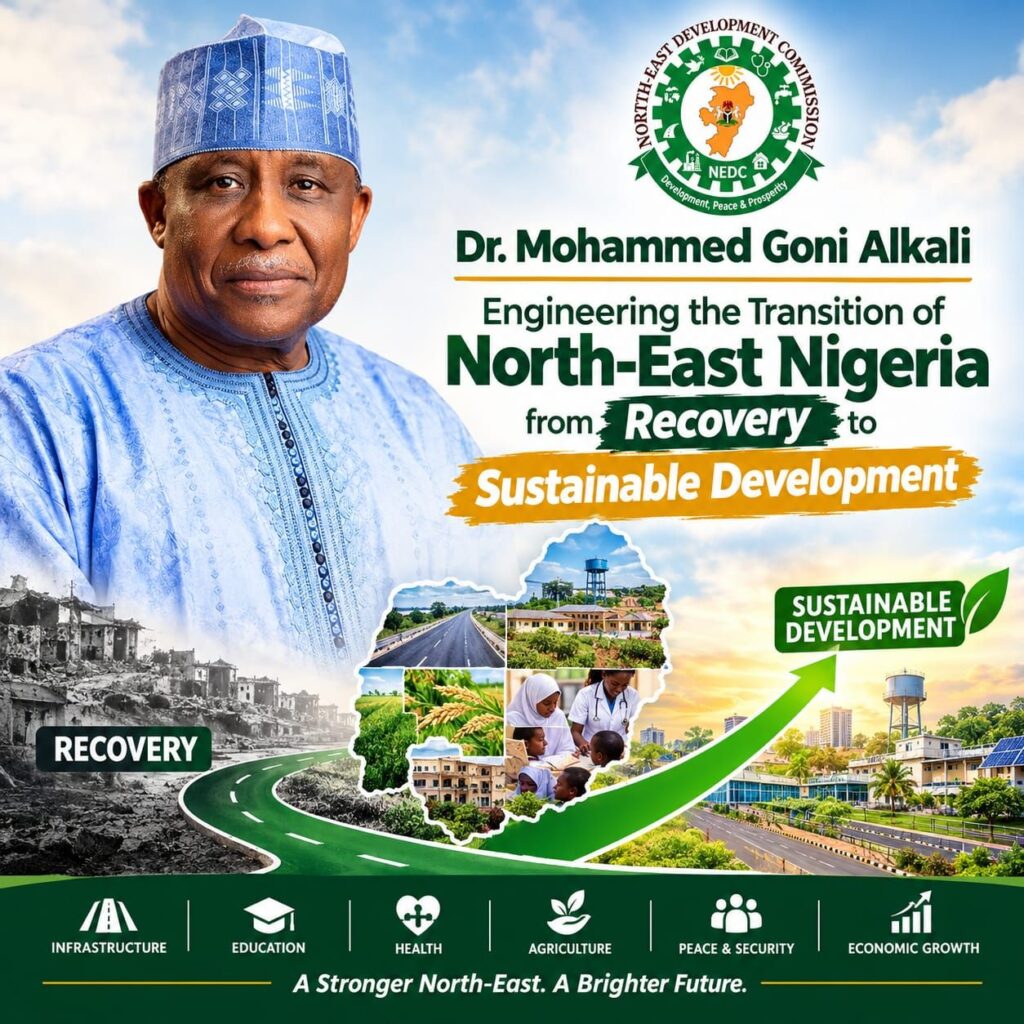
The story of rebuilding Nigeria’s North-East is inseparable from the challenge of converting the devastation caused by prolonged insecurity, displacement and infrastructure deficits into a sustainable foundation for peace, economic opportunity and human development. At the centre of this institutional effort is the North-East Development Commission (NEDC) and its Managing Director and Chief Executive Officer, Dr. Mohammed Goni Alkali.
Since assuming leadership of the Commission in 2019, Alkali has overseen an approach that places reconstruction within a broader development framework. Rather than treating roads, schools, healthcare, agriculture, livelihoods and humanitarian interventions as isolated activities, the NEDC’s strategy is anchored on the North-East Stabilisation and Development Master Plan (NESDMP) 2020–2030, a long-term framework built around 11 development pillars.
A Professional Foundation in Finance and Development
Alkali’s professional background provides an important context for understanding his role at the NEDC.
He holds a First-Class degree in Accounting from Bayero University, Kano, obtained in 1983, and a Master’s degree in Accounting and Finance from the London School of Economics, University of London, obtained in 1986. He began his career in academia at the University of Maiduguri before moving into banking in 1988.
His banking career extended for more than two decades and included senior responsibilities at the Bank of Industry, where he served as General Manager for Large Enterprises, General Manager for SMEs and subsequently Executive Director, Operations. He was also involved in national economic initiatives, including the Federal Government’s Rice Processing Intervention Fund and the Cotton, Textile and Garment Development Scheme.
The Street Journal
This combination of accounting, banking, development finance and institutional management is relevant to the NEDC’s mandate, which requires the coordination of large-scale interventions across six states while balancing infrastructure, economic development and social needs.
From Reconstruction to a Comprehensive Development Agenda
The defining feature of the NEDC’s strategic approach under Alkali is the effort to move beyond emergency reconstruction towards long-term regional transformation.
The NESDMP 2020–2030 provides the framework. Its 11 pillars cover:
Peaceful Society
Connected Region
Leadership in Agriculture
Healthy Citizens
Educated Populace
Flourishing Trade
Productive Entrepreneurs
Purposeful Infrastructure
Industrialisation
Memorable Experience
Protected Environment
The master plan also incorporates principles such as good governance, employment and job creation, youth development, gender balance, inclusion of persons with disabilities and sustainable financing.
This framework is significant because it recognises that physical reconstruction alone cannot produce lasting development. Roads must connect productive communities to markets; schools must produce employable young people; electricity must support businesses; healthcare must strengthen human capital; and agricultural interventions must contribute to food security and household incomes.
Infrastructure as an Engine of Regional Connectivity
Infrastructure remains one of the most visible dimensions of NEDC intervention.
Projects reported by the Commission and the media include roads and bridges designed to connect communities, improve mobility and support economic activity.
Among the examples are the Jere Bowl road network in Borno, the Dabna–Garkida road in Adamawa, and the Mutai–Ngalda road in Yobe.
The significance of such infrastructure goes beyond the physical road itself.
In an agrarian region, a road can determine whether farmers can transport produce to markets, whether communities can access healthcare and education, and whether commercial activity can expand.
The NEDC’s infrastructure strategy has also broadened. In July 2026, the Commission announced plans involving a 50-megawatt power project, a proposed North-East railway and an additional ₦100 billion allocation for roads and bridges.
These initiatives indicate an attempt to connect reconstruction with the larger question of regional productivity.
A New Emphasis on Energy and Industrialisation
One of the notable developments in the NEDC’s current agenda is the increasing emphasis on energy and industrial development.
In 2026, the Commission announced plans for the deployment of more than 10,000 electric vehicles across the six North-East states, including electric taxis, minibuses and buses, alongside charging and maintenance infrastructure.
The wider electric-mobility agenda has potential implications for youth employment, technical skills, entrepreneurship, transportation and environmental sustainability. It also fits into the NESDMP’s broader industrialisation and connected-region objectives.
Similarly, the Commission has been developing an Electric Vehicle Assembly Plant concept for the region. Such initiatives represent an important shift in development thinking: from rebuilding what conflict destroyed to creating industries and technologies capable of supporting the region’s future economy.
Investment on an Expanding Scale
The scale of NEDC’s current project portfolio illustrates the increasing ambition of the intervention.
In September 2026, Alkali stated that the Commission’s portfolio of executed, ongoing and upcoming projects had crossed the ₦1.5 trillion mark. He put the value of roads, bridges and other physical infrastructure at about ₦800 billion, with additional projects expected to raise the overall portfolio to approximately ₦1.5 trillion.
Among the projects he highlighted were an e-banking initiative and the deployment of 50 megawatts of mini-grid infrastructure.
These figures should be understood as reported project-portfolio values rather than as a single amount of money already spent. The distinction is important because the portfolio includes executed, ongoing and upcoming projects.
Human Capital as a Development Strategy
A major challenge facing the North-East is not merely physical reconstruction but the development of human capacity.
The region has a large youthful population, making education, vocational training, entrepreneurship and employment central to its long-term stability.
NEDC interventions therefore extend into schools, healthcare, livelihood programmes and skills development.
Earlier reporting documented projects involving mega schools, hospitals, mass housing and other social infrastructure, alongside roads and bridges.
The underlying principle is straightforward: sustainable reconstruction requires people who can operate, maintain and expand the infrastructure being created.
Institutional Excellence and the ISO Agenda
Perhaps one of the more important recent developments under Alkali is the emphasis on the institution itself.
In September 2026, NEDC held its Excellence Forum 2026 in Maiduguri and subsequently an executive retreat in Abuja. The initiatives followed the Commission’s certification to five ISO management-system standards covering quality management, environmental management, occupational health and safety, anti-bribery management and sustainable development in communities.
Alkali’s emphasis was that certification should not become an end in itself. The standards, according to his stated position, should influence how decisions are made, how resources are managed and how development programmes are delivered.
This is particularly important for an intervention agency handling a large and geographically dispersed portfolio.
Strong internal systems can help ensure that planning, procurement, monitoring, risk management and implementation are treated as parts of the same development chain.
The Security-Development Connection
The NEDC operates in a region where insecurity has historically affected access to communities and disrupted development projects.
In 2024, Alkali reported that approximately 600 NEDC projects had been stalled by insurgent activity, illustrating the direct relationship between security and development delivery.
The Nation
This presents a fundamental development dilemma: infrastructure can support stability, but insecurity can prevent infrastructure from being constructed or maintained.
Consequently, reconstruction in the North-East cannot be separated from peacebuilding. The first pillar of the NESDMP—Peaceful Society—reflects this understanding.
Governance, Accountability and Sustainable Delivery
The increasing emphasis on institutional standards also reflects a broader question about public-sector development: how can large interventions remain effective beyond individual projects?
NEDC’s 2026 institutional programmes have focused on staff capacity, accountability, integrity, quality management and the practical application of international standards. The Commission has stated that the ultimate test of these systems is their effect on development delivery to communities.
For an organisation implementing interventions across Borno, Adamawa, Yobe, Bauchi, Gombe and Taraba, institutional capacity is therefore not merely an administrative issue.
It is directly connected to the quality and sustainability of regional development.
The Larger Vision: From Recovery to Prosperity
The most significant aspect of Alkali’s tenure can be understood through the evolution of the NEDC’s development philosophy.
The initial challenge was reconstruction: rebuild roads, schools, houses and public facilities damaged by conflict.
The emerging challenge is broader: How does the North-East become productive, connected, industrialised and economically self-sustaining?
That transition requires a different type of intervention.
It requires:
reliable infrastructure;
electricity and renewable energy;
productive agriculture;
functioning markets;
industrialisation;
entrepreneurship;
quality education;
healthcare;
youth employment;
environmental sustainability;
tourism and cultural development; and
stronger institutions.
These priorities correspond closely with the architecture of the region.
A Leadership Story That Extends Beyond Individual Projects
Assessments of Alkali’s tenure have often focused on the number and visibility of NEDC projects. Various media reports have described the Commission’s infrastructure and intervention portfolio as having expanded substantially under his leadership.
A fuller assessment, however, requires looking beyond individual projects.
The more consequential question is whether the interventions collectively contribute to regional resilience, whether roads connect communities to markets, whether schools improve human capital, whether energy enables enterprises, whether agriculture generates incomes, whether healthcare improves wellbeing and whether institutions can sustain the gains.
That is the logic behind the shift from reconstruction to development.
In Conclusion,
Dr. Mohammed Goni Alkali’s tenure as Managing Director and Chief Executive Officer of the North-East Development Commission is taking place against one of the most complex development challenges in contemporary Nigeria: rebuilding a region affected by conflict while simultaneously creating the foundations for sustainable economic growth.
His professional background in accounting, banking and development finance has coincided with an NEDC strategy structured around the 11 pillars of the North-East Stabilisation and Development Master Plan.
The Commission’s expanding infrastructure portfolio, investments in energy and mobility, social-sector interventions, human-capital programmes and recent emphasis on ISO-based institutional systems demonstrate the breadth of the development agenda. Recent announcements on a 50MW power initiative, proposed railway, additional roads and bridges, electric mobility and a project portfolio reported at about ₦1.5 trillion further illustrate the scale of the current ambition.
Ultimately, the enduring measure of any development programme is not simply the number of projects announced or commissioned, but the extent to which those interventions improve the daily lives of citizens and create conditions for communities to become more secure, productive and economically resilient.
For the North-East, the strategic objective is therefore larger than reconstruction.
It is the creation of a region capable of moving from recovery to renewal, from renewal to expansion, and ultimately towards sustainable prosperity.


