From Recovery to Prosperity: Building a Stronger, More Resilient and Economically Vibrant North-East
The journey towards sustainable development in Nigeria’s North-East region requires visionary leadership, strategic planning, institutional commitment and a clear understanding of the challenges confronting its people. For a region that has endured years of insecurity, displacement, destruction of infrastructure and economic disruption, the task of rebuilding goes beyond restoring what was lost. It demands a deliberate commitment to creating new opportunities, strengthening communities and laying the foundation for lasting prosperity.
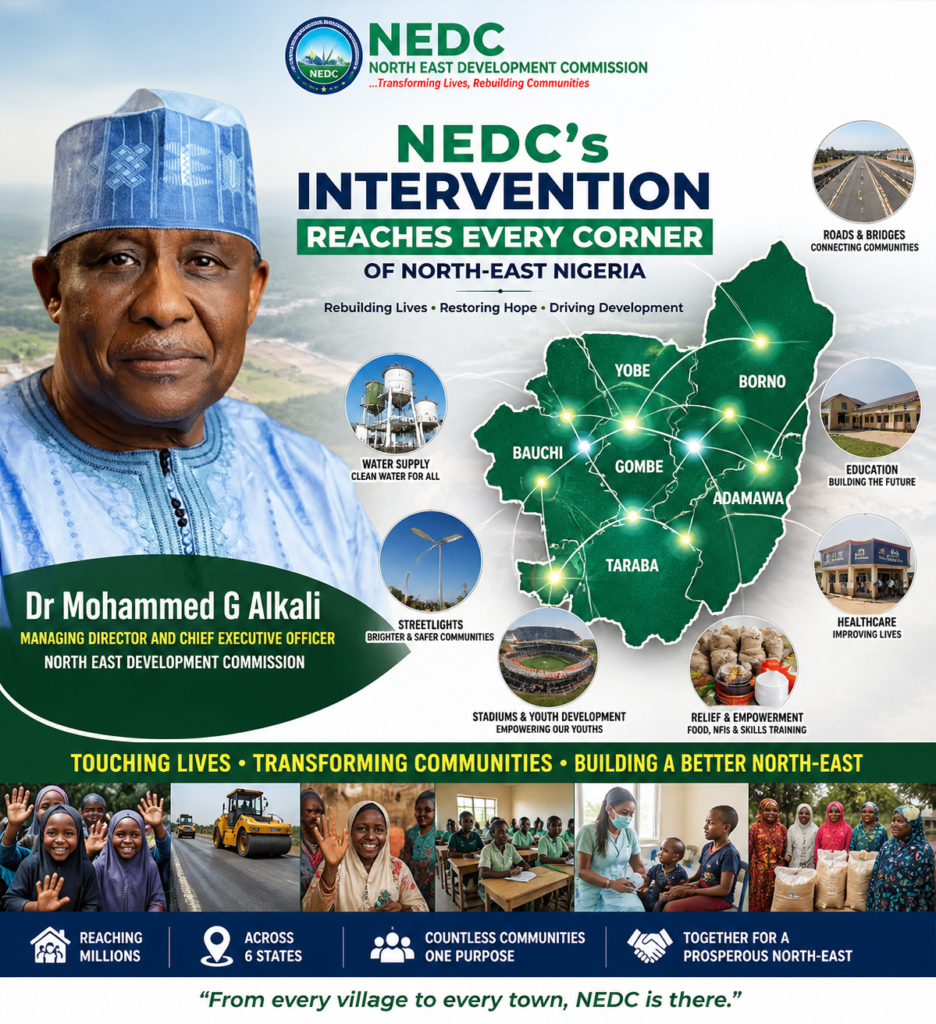
Under the leadership of Dr. Mohammed G. Alkali, Managing Director and Chief Executive Officer of the North-East Development Commission (NEDC), the pathway towards regional success is anchored on the vision of transforming the North-East from a region recovering from adversity into one characterised by sustainable development, economic resilience and shared prosperity.
Dr. Alkali’s leadership represents an important opportunity to align reconstruction, rehabilitation, infrastructure development, human capital investment and economic empowerment within a coordinated regional development framework. The ultimate objective is to ensure that development initiatives translate into meaningful improvements in the lives of ordinary citizens across the six states of Adamawa, Bauchi, Borno, Gombe, Taraba and Yobe.
Strategic Leadership and a Clear Development Vision
Successful regional transformation begins with leadership capable of identifying priorities, coordinating institutions and translating development objectives into practical outcomes. In a region as diverse and complex as the North-East, effective leadership requires balancing immediate humanitarian needs with long-term economic and infrastructural priorities.
As head of the NEDC, Dr. Mohammed G. Alkali occupies a strategic position in advancing the Commission’s mandate to support the rehabilitation, reconstruction and development of the region. The responsibility requires a comprehensive approach that recognises the connections between security, infrastructure, education, healthcare, agriculture, commerce and employment.
A major strength of a well-coordinated regional development strategy is its ability to ensure that projects are not implemented in isolation. Roads must connect communities to markets; electricity must support businesses and public institutions; schools must prepare young people for employment; and vocational training must equip beneficiaries with practical skills that respond to economic needs.
This interconnected approach is essential to building a development model in which investments reinforce one another and generate lasting benefits.
From Recovery to Prosperity
The North-East’s development journey must move beyond emergency interventions towards sustainable economic growth. While reconstruction remains necessary in communities affected by conflict, the broader objective is to create an environment in which individuals, families, businesses and institutions can thrive.
The transition from recovery to prosperity requires deliberate investment in productive infrastructure, local enterprise, human capital and economic opportunities. It also requires ensuring that reconstruction projects are durable, accessible and responsive to the needs of the communities they serve.
Under Dr. Alkali’s leadership, the NEDC’s regional development agenda can contribute to this transition by supporting projects that address immediate infrastructure gaps while creating opportunities for future economic expansion.
The success of this approach should ultimately be measured not merely by the number of projects completed, but by the improvements those projects bring to people’s lives. Better access to healthcare, improved learning environments, reliable infrastructure, stronger local businesses and increased employment opportunities are among the outcomes that can make development meaningful to the population.
Infrastructure as the Foundation of Regional Transformation
Infrastructure is one of the most important pillars of sustainable development. Without functional roads, dependable electricity, adequate water supply and accessible public facilities, communities struggle to attract investment, expand commercial activities and improve living standards.
For the North-East, the rehabilitation and expansion of critical infrastructure can strengthen connections between rural communities and urban centres, facilitate the movement of agricultural produce, improve access to essential services and reduce the costs associated with doing business.
Road construction and rehabilitation can open up previously underserved communities to economic opportunities. Investments in water, sanitation and public facilities can improve public health and community welfare. Similarly, electricity projects can support schools, healthcare centres, small businesses and industrial activities.
The challenge is to ensure that infrastructure development is guided by clear priorities, sound technical standards, geographical balance and effective monitoring.
Through strategic coordination and responsible project implementation, the NEDC can continue to contribute to an infrastructure network that supports economic integration and creates a stronger foundation for regional prosperity.
Electric Mobility and the Future of Youth Employment
One of the emerging opportunities for the North-East is the development of new industries capable of creating jobs, strengthening technical capacity and preparing young people for the changing demands of the global economy.
Electric mobility presents an opportunity to explore the intersection of technology, transportation, industrial development and youth empowerment. Initiatives associated with electric vehicle assembly, technical training and partnerships with relevant industrial organisations could help develop local expertise while opening new pathways for skilled employment.
The prospect of electric mobility development in the region reflects the importance of looking beyond traditional approaches to economic recovery. By investing in technical education, practical skills and emerging technologies, the North-East can position its young population to participate in new areas of economic activity.
Under Dr. Mohammed G. Alkali’s leadership, the advancement of such initiatives would be particularly significant if supported by sustainable infrastructure, appropriate technical standards, reliable power supply, maintenance capacity and partnerships that promote knowledge transfer.
The broader objective is to ensure that young people are not merely observers of technological change but active participants in the industries shaping the future.
Human Capital Development: Investing in the People
No region can achieve lasting prosperity without investing in its people. Education, vocational training, healthcare and entrepreneurship are essential components of a comprehensive development strategy.
The North-East has a large youth population whose energy, creativity and determination can become powerful drivers of economic growth when supported by the right opportunities.
Skills acquisition programmes can help young people gain practical competencies in areas such as electrical installation, welding, fabrication, construction, information technology and other technical fields. When linked to industry requirements and employment opportunities, these programmes can improve employability and encourage self-reliance.
Likewise, investments in schools and healthcare facilities can strengthen the social foundations of development. Quality education equips future generations with knowledge and skills, while accessible healthcare enables individuals and communities to live healthier and more productive lives.
For these investments to achieve their full potential, attention must also be given to the quality of training, the availability of learning materials, the competence of instructors and the long-term functionality of completed facilities.
The real measure of human capital development is the ability of beneficiaries to translate knowledge and skills into improved livelihoods.
Agriculture, Enterprise and Economic Diversification
Agriculture remains central to the livelihoods of many people across the North-East. The region’s agricultural potential provides an important foundation for economic recovery, food security and employment generation.
However, unlocking this potential requires more than agricultural production alone. Farmers need access to markets, storage facilities, irrigation where appropriate, processing infrastructure, affordable inputs and reliable transportation.
Supporting agricultural value chains can create opportunities for farmers, transport operators, processors, traders and small-scale manufacturers. Local processing can also help communities retain more economic value from their agricultural output.
Alongside agriculture, small and medium-sized enterprises remain important to the development of a resilient regional economy. Businesses operating in retail, construction, transportation, food processing, technology and other sectors can generate employment and support household incomes.
A development strategy that strengthens local enterprises, improves access to relevant support and encourages private-sector participation can help reduce economic vulnerability and broaden the region’s sources of growth.
The objective should be to build an economy in which communities are not dependent solely on public interventions but possess the productive capacity to generate sustainable wealth.
Peace, Security and Community Resilience
Development and security are closely connected. Communities affected by insecurity require more than physical reconstruction; they also need opportunities that restore confidence, strengthen social relationships and support the return of productive economic activity.
Infrastructure, education, healthcare and livelihood programmes can contribute to community resilience by addressing some of the socioeconomic pressures that accompany displacement and economic disruption.
Nevertheless, development interventions must complement, rather than replace, the work of security agencies and other relevant institutions. Sustainable progress requires coordination among federal and state governments, local authorities, traditional institutions, civil society organisations, development partners and community representatives.
Equitable access to development opportunities is also important. When communities can see that their needs are being considered and that public investments are producing tangible benefits, confidence in development institutions can grow.
Under Dr. Alkali’s leadership, sustained attention to inclusive reconstruction and community-focused development can help strengthen the social and economic foundations upon which lasting peace depends.
Accountability, Transparency and Sustainable Project Delivery
The success of any regional development agenda depends not only on the quality of its vision but also on the effectiveness of its implementation.
Strategic planning must be accompanied by transparent procurement, competent project supervision, responsible financial management and regular evaluation. Projects should be selected according to clearly defined needs, realistic budgets and measurable development objectives.
Monitoring mechanisms are equally important. They help determine whether projects are progressing as planned, whether beneficiaries are receiving the intended services and whether completed facilities remain functional.
Public communication can further strengthen accountability by enabling communities to understand project objectives, implementation timelines and expected benefits.
For the NEDC, these principles are essential to ensuring that resources devoted to regional development produce lasting value. They also provide a framework for identifying implementation challenges early and making the necessary adjustments.
Leadership becomes more impactful when its vision is supported by strong institutions, measurable results and a commitment to continuous improvement.
Inclusive Development Across the Six States
The North-East is not a uniform region. Its six states possess different economic strengths, infrastructure needs, environmental conditions and development priorities. A successful regional strategy must recognise these differences while pursuing common objectives.
Some communities may require urgent rehabilitation of damaged infrastructure, while others may benefit most from agricultural investment, technical training, water projects or support for local enterprise.
A balanced approach should therefore combine region-wide priorities with interventions tailored to the needs of individual communities. It should also encourage cooperation between states, facilitate the sharing of successful practices and promote projects that strengthen economic connections across state boundaries.
Inclusion must extend to women, young people, persons with disabilities, displaced households and vulnerable communities. Their participation in development planning and access to economic opportunities are important to ensuring that regional progress is broad-based.
The ultimate ambition is a North-East where geographical location or socioeconomic circumstances do not permanently determine a person’s access to opportunity.
The Road Ahead: Consolidating Progress and Expanding Opportunities
The pathway towards the success of the North-East requires sustained commitment, effective coordination and a willingness to embrace new ideas. The region’s challenges are significant, but its human resources, agricultural potential, entrepreneurial energy and strategic importance provide strong foundations for future growth.
Several priorities deserve continued attention: completing and maintaining critical infrastructure, strengthening education and healthcare, expanding technical and vocational training, supporting agricultural value chains, promoting entrepreneurship, improving access to clean water and electricity, and ensuring that development programmes reach underserved communities.
Equally important is the need to strengthen partnerships between the NEDC, state governments, local communities, the private sector and development partners. No single institution can independently address every dimension of regional development.
A coordinated approach can help mobilise expertise, reduce duplication, improve resource utilisation and create stronger links between public investment and private economic activity.
For Dr. Mohammed G. Alkali, the enduring significance of leadership will be reflected in the institution’s capacity to turn development priorities into tangible, sustainable benefits for the people of the North-East.
Conclusion: A Shared Journey Towards Sustainable Prosperity
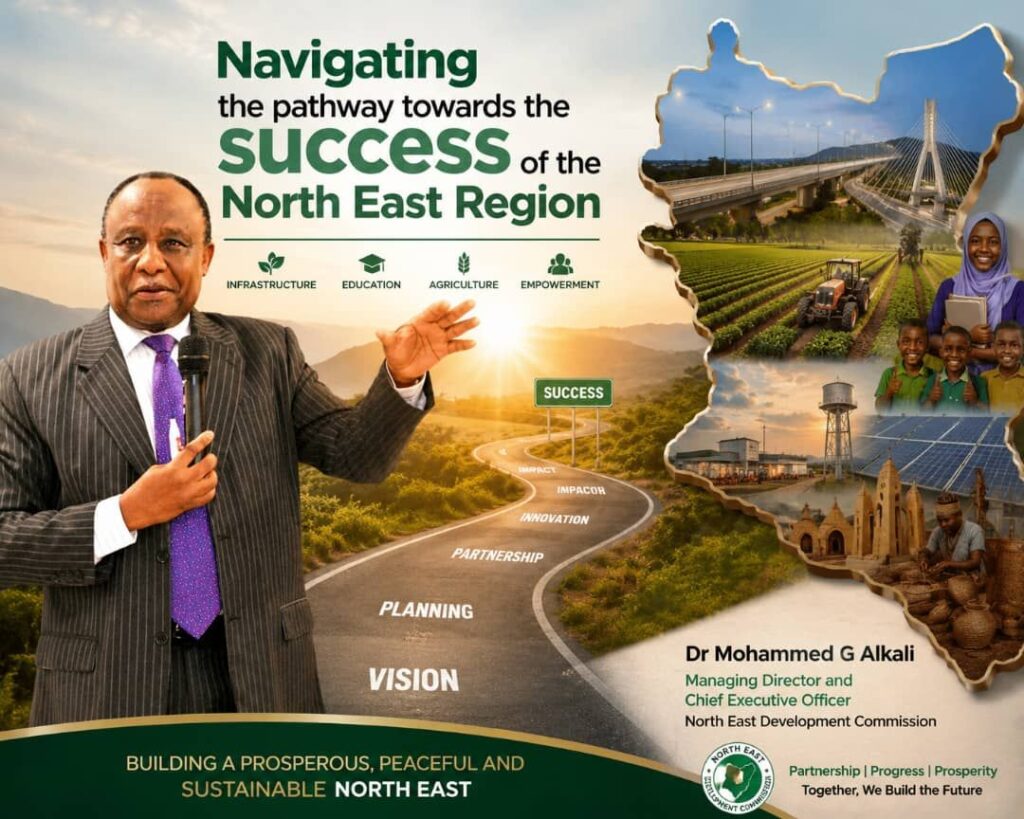
Navigating the pathway towards the success of the North-East region demands more than ambition; it requires strategic direction, practical implementation, accountability and a shared commitment to improving the lives of its people.
Under the leadership of Dr. Mohammed G. Alkali, Managing Director and Chief Executive Officer of the North-East Development Commission, the region has an important institutional platform through which reconstruction, infrastructure development, human capital investment and economic empowerment can be pursued in a coordinated manner.
The journey from recovery to prosperity will depend on the continuity of effective programmes, the quality of project delivery, strong partnerships and the ability to translate development investments into measurable improvements in community welfare.
Ultimately, the success of the North-East should be reflected in thriving businesses, empowered young people, better schools and healthcare facilities, stronger agricultural production, improved infrastructure and communities equipped to pursue peaceful and productive lives.
The vision is clear: a North-East that does not merely recover from past challenges, but emerges stronger, more resilient, more economically competitive and better prepared for the future.
With strategic leadership, collective responsibility and sustained commitment to inclusive development, the pathway towards a more prosperous North-East can become a lasting reality. North-East Development Commission: Advancing the journey from recovery to prosperity.