Transforming the North-East Through Infrastructure, Human Capital Development and Sustainable Prosperity
*By his commitment to purposeful leadership, people-centred development and institutional responsibility, Dr Mohammed G. Alkali, Managing Director and Chief Executive Officer of the North-East Development Commission (NEDC), stands at the forefront of the continuing effort to rebuild communities, restore hope and unlock the vast potential of Nigeria’s North-East.*
Introduction: Leadership That Makes a Difference
Leadership is best understood not merely through titles or public pronouncements, but through the quality of decisions made, the challenges confronted and the positive changes achieved in people’s lives.
For Nigeria’s North-East, a region that has endured years of insurgency, displacement, damaged infrastructure and economic disruption, the task of reconstruction requires more than administrative competence. It demands vision, courage, compassion and the determination to turn difficult circumstances into opportunities for renewal.
It is within this context that the leadership of Dr Mohammed G. Alkali at the North-East Development Commission deserves recognition. Under his stewardship, the Commission has pursued interventions across infrastructure, education, healthcare, water and sanitation, security-related reconstruction and human capital development.
These interventions reflect the breadth of the NEDC’s mandate: to support the rehabilitation, reconstruction and sustainable development of Adamawa, Bauchi, Borno, Gombe, Taraba and Yobe states.
More importantly, they illustrate a development philosophy in which vision provides direction, action delivers results and compassion ensures that people remain at the heart of public service.
1. A Visionary Leader Turning Challenges into Opportunities
Visionary leadership is the ability to see beyond present difficulties and develop a practical pathway towards a better future.
For the North-East, that future must be built upon restored infrastructure, stronger educational institutions, accessible healthcare, improved livelihoods, reliable public services and a regional economy capable of generating sustainable opportunities.
The North-East Development Commission’s interventions demonstrate the importance of translating this ambition into tangible projects.
In July 2026, reports on the Commission’s performance indicated that it had achieved approximately 80 per cent of its mandated interventions, according to Dr Alkali. This assessment reflects the scale of the reconstruction effort undertaken across the region, although the percentage is the Commission’s reported assessment rather than an independently verified completion audit.
The Commission has also developed and implemented its North-East Stabilisation and Development Master Plan, a long-term framework intended to move the region from recovery and stabilisation towards renewal, expansion and consolidation.
This approach recognises that rebuilding the North-East must extend beyond replacing what was destroyed. It must create the conditions for economic growth, social stability and sustainable prosperity.
2. Infrastructure Development: Reconnecting Communities and Expanding Opportunities
One of the clearest expressions of visionary leadership is the ability to deliver infrastructure that responds to the everyday needs of citizens.
According to achievement figures reported by the Commission in 2026, the NEDC has completed more than **300 kilometres of roads and over 50 bridges** across the North-East. These investments are important for reconnecting communities, improving access to markets, facilitating the movement of goods and services, and reducing the isolation of rural settlements.
Strategic road and bridge projects have included interventions such as the 32-kilometre Dabna Road in Adamawa State, the Kirfi–Gombe Abba Road in Bauchi State and the 54-kilometre Mutai–Ngalda Road in Yobe State. These corridors support connectivity and provide improved access to economic and social services.
The Commission has also undertaken significant rural and urban lighting interventions. Reports in 2026 indicated that more than **100,000 solar-powered streetlights** had been installed across the region, with further installations planned.
These interventions can improve visibility at night, support commercial activities and contribute to a more secure environment for communities.
The importance of these achievements lies not simply in the number of kilometres of roads constructed or bridges completed, but in the opportunities that better connectivity creates for farmers, traders, students, healthcare workers and entrepreneurs.
Infrastructure, in this sense, becomes an instrument of inclusion and economic transformation.
3. Education: Building the Human Capital of a New North-East
A region cannot achieve lasting prosperity without investing in its people. Education is therefore one of the most important foundations of the North-East’s recovery and long-term development.
The NEDC has reported the completion of **18 mega schools across the six North-East states**, representing three schools in each state. These facilities are intended to improve access to learning and provide more supportive environments for students.
In addition, the Commission has reported the completion of **49 projects in tertiary institutions** across the region.
These interventions are significant in a region where years of insecurity have disrupted education and deprived many young people of opportunities to acquire the knowledge and skills needed for productive lives.
The Commission’s education-related investments demonstrate an understanding that rebuilding classrooms and educational facilities is an investment in the future workforce, the region’s intellectual capacity and its ability to compete in an increasingly knowledge-driven economy.
A school is more than a physical structure. It is a place where possibilities are discovered, talent is developed and future leaders are prepared.
By supporting educational infrastructure, the NEDC is contributing to the foundations upon which a more educated, skilled and productive North-East can emerge.
4. Healthcare: Bringing Advanced Medical Services Closer to the People
Compassionate leadership is particularly evident in the effort to improve access to quality healthcare.
For many residents of the North-East, access to advanced diagnostic services has historically been limited, often requiring patients to travel long distances to obtain specialised medical investigations.
In 2026, Dr Alkali reported a major expansion in the region’s diagnostic capacity, with the number of MRI machines increasing from one previously functional machine across the zone to a planned complement of eight advanced machines. The Commission has also reported providing CT scanners and other diagnostic equipment to healthcare institutions.
These interventions are intended to improve the diagnosis and management of complex medical conditions, strengthen tertiary healthcare services and reduce the need for patients to seek treatment outside the region.
The Commission has also undertaken specialised health infrastructure projects. Among the facilities reported in its interventions are the remodelling and equipping of the Borno State Eye and Dental Hospital, the provision of an ultramodern clinic at the DSS quarters in Maiduguri, and the development of medical facilities at the Federal Neuro-Psychiatric Hospital.
These projects complement the broader objective of strengthening the healthcare system and improving the availability of essential medical services.
The Commission has also announced plans to expand the Community Targeted Social Health Insurance Programme to approximately 10,000 vulnerable beneficiaries, including people affected by displacement.
Together, these interventions illustrate the people-centred dimension of development: a healthier population is better positioned to learn, work, raise families and contribute to regional prosperity.
5. Water, Sanitation and Environmental Well-being
Access to safe water and adequate sanitation is fundamental to public health, human dignity and community resilience.
The NEDC has reported the completion of more than **100 water, sanitation and hygiene (WASH) facilities** across the region. It has also undertaken borehole projects intended to improve access to water in communities where shortages affect households, schools and public institutions.
In one set of interventions reported in Borno State in 2025, the Commission highlighted the construction of 60 boreholes alongside the installation of 3,500 streetlights.
Such projects address practical needs that directly affect daily life. Reliable water access can reduce the burden of water collection, support hygiene and improve conditions in schools and healthcare facilities.
These achievements reinforce the principle that development must be measured not only by large infrastructure projects but also by the essential services that enable communities to live healthier and more productive lives.
6. Humanitarian Support, Reconstruction and Community Resilience
The North-East’s development challenge is inseparable from the human consequences of prolonged conflict, displacement and natural disasters.
For affected households, rebuilding often begins with access to shelter materials, restored public facilities, essential services and opportunities to recover lost livelihoods.
The NEDC has undertaken reconstruction support and humanitarian interventions to complement the efforts of state governments and other development partners.
In Yobe State, for example, the Commission has provided support to communities affected by flooding. Its broader reconstruction work has also included infrastructure and institutional facilities intended to strengthen community recovery.
In Borno State, the Commission has supplied building materials, including blocks, nails and roofing sheets, to complement reconstruction efforts undertaken by the state government.
These interventions reflect the importance of cooperation between institutions in responding to the needs of affected populations.
The long-term objective must remain the transition from immediate relief to sustainable recovery: helping communities rebuild not only their homes and public facilities, but also their livelihoods, confidence and capacity to withstand future shocks.
7. Institutional Development and Strategic Presence Across the Region
Effective development requires institutions that can plan, coordinate and implement projects in response to local needs.
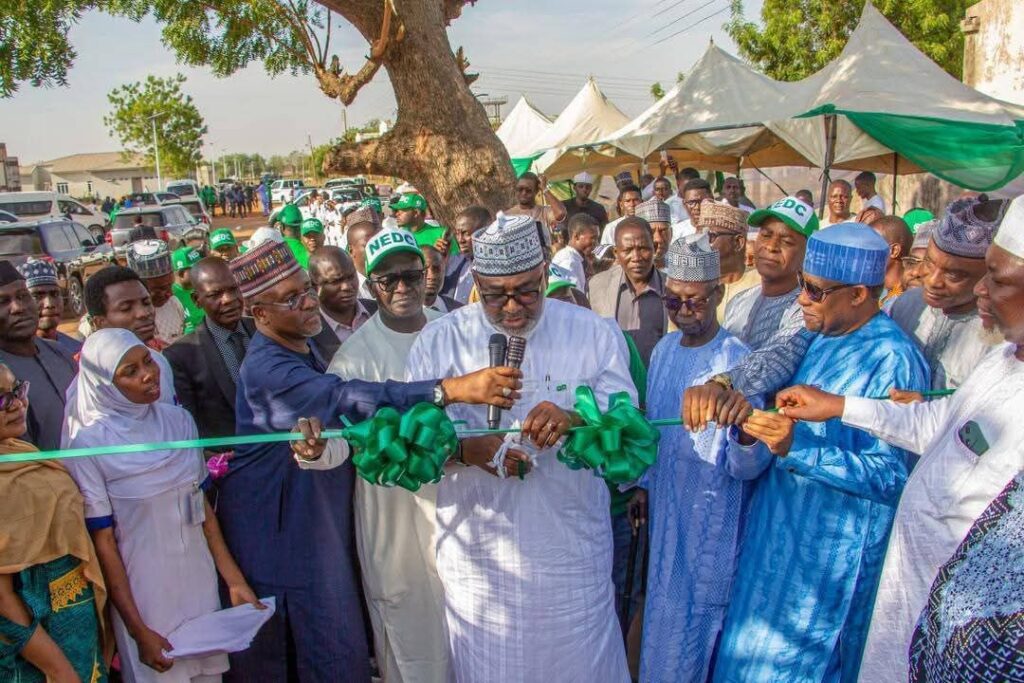
In June 2025, the NEDC inaugurated key infrastructure and capacity-building projects in Yobe State. These included a state office complex in Damaturu, ICT centres in Damaturu, Gashua and Potiskum, and mega schools in Buni Yadi and Potiskum.
The Commission also reported the construction of a 250-seat auditorium at Yobe State University.
The establishment of state-level facilities and ICT infrastructure supports institutional capacity, improves access to technology and helps bring development activities closer to communities.
Such investments are important because sustainable reconstruction depends not only on the delivery of physical projects but also on the institutions required to maintain, manage and build upon them.
8. New Frontiers: Renewable Energy, Enterprise and Economic Transformation
As the North-East progresses from reconstruction towards long-term development, the next challenge is to create an economy capable of supporting jobs, investment and greater productivity.
The Commission has announced new initiatives intended to advance this transition.
In July 2026, the NEDC announced approval for a proposed *₦100* billion, 50-megawatt solar mini-grid programme. The initiative is intended to improve electricity access for homes, schools, healthcare facilities, markets, industrial parks and small businesses across the region.
The Commission has also announced a flagship electric mobility programme, beginning with an initial rollout of 300 electric vehicles as part of a phased plan for a much larger fleet. The programme is intended to modernise transport, create employment opportunities and encourage investment in supporting infrastructure.
In addition, the Governing Board approved the establishment of a *₦30* billion NEDC–Bank of Industry Micro, Small and Medium Enterprises Development Fund**. The proposed fund is designed to improve access to finance, business development services and capacity-building support, particularly for youth- and women-owned enterprises.
These initiatives should be distinguished from projects already completed: they represent approved or proposed investments whose full impact will depend on implementation, operational effectiveness and sustained oversight.
Nevertheless, their strategic significance is clear. Reliable electricity can support small industries and agro-processing; improved transport can connect producers to markets; and accessible business finance can help entrepreneurs transform ideas into viable enterprises.
This integrated approach provides a pathway towards economic diversification and a more productive regional economy.
9. Accountability, Standards and Responsible Public Service
Vision and ambition must be supported by sound institutional governance.
Public development institutions carry a responsibility to ensure that projects meet required standards, public resources are used prudently and interventions deliver measurable benefits.
In 2026, the NEDC reported attaining five ISO certifications covering quality management, environmental management, occupational health and safety, anti-bribery management and sustainable community development.
These certifications are an important institutional milestone. They provide recognised frameworks for strengthening management systems, improving processes and reinforcing commitments to quality, integrity and responsible operations.
The Commission’s continued challenge is to translate these systems into consistently effective project delivery, transparent reporting, maintenance of completed infrastructure and measurable improvements in community welfare.
The enduring credibility of public service depends on the confidence citizens can place in the institutions entrusted with their resources and aspirations.
10. Compassion as a Guiding Principle of Leadership
Behind every road, school, hospital, borehole and business support programme are people whose lives can be improved through effective public service.
For a region recovering from conflict, compassion requires an understanding of the circumstances of displaced families, vulnerable children, unemployed young people, struggling entrepreneurs and communities rebuilding their livelihoods.
It means ensuring that development is inclusive and that vulnerable populations are not excluded from the benefits of public investment.
Compassion also demands listening to communities, understanding local priorities and recognising that the success of an intervention depends on whether it addresses a genuine need.
Dr Alkali’s responsibilities as head of the NEDC place these considerations at the centre of the Commission’s development mandate. The ultimate test of such leadership is the extent to which institutional programmes improve access to services, create opportunities and restore confidence in the future.
11. A Legacy of Action, Purpose and Shared Prosperity
The achievements and ongoing initiatives of the North-East Development Commission illustrate the breadth of the task facing a regional development institution.
Roads and bridges strengthen connectivity. Schools expand educational opportunities. Diagnostic equipment improves healthcare capacity. Water and sanitation facilities support public health. Solar lighting improves community infrastructure. Enterprise and energy initiatives offer opportunities to stimulate economic growth.
These interventions are most meaningful when considered as parts of a connected development strategy rather than isolated projects.
The task ahead remains substantial. Completed infrastructure must be maintained, new projects must be implemented effectively, and development benefits must reach communities across all six states.
The Commission’s continued success will depend on institutional discipline, constructive partnerships, responsible investment and the active participation of the people it serves.
Under Dr Mohammed G. Alkali’s leadership, the NEDC’s central ambition remains to help transform a region affected by prolonged adversity into one defined increasingly by resilience, opportunity and sustainable progress.
Conclusion: A Visionary Leader of Action, Compassion and Purpose
Dr Mohammed G. Alkali’s leadership at the North-East Development Commission can be understood through three defining ideals.
**Vision** provides the direction for a region seeking to move beyond reconstruction towards sustainable development.
**Action** is reflected in reported achievements across roads, bridges, schools, healthcare facilities, solar streetlighting and water infrastructure, alongside new initiatives intended to strengthen energy access and enterprise development.
**Compassion** ensures that the purpose of these interventions remains connected to the needs, dignity and aspirations of the people of the North-East.
The significance of leadership lies ultimately in its ability to bring these ideals together: to translate ambition into implementation, investment into opportunity and public service into meaningful social progress.
The North-East’s journey towards lasting prosperity requires sustained commitment from government, communities, development partners and the private sector. It also requires institutions capable of turning shared aspirations into practical and measurable outcomes.
The NEDC’s development journey offers an important platform for that collective effort.
*A visionary leader of action, compassion and purpose is one who sees beyond present challenges, works towards practical solutions and understands that the true measure of development is the positive difference it makes in people’s lives.*
For the North-East, the aspiration is clear: to rebuild with determination, develop with purpose and create a future in which peace, opportunity and prosperity are shared by all.