
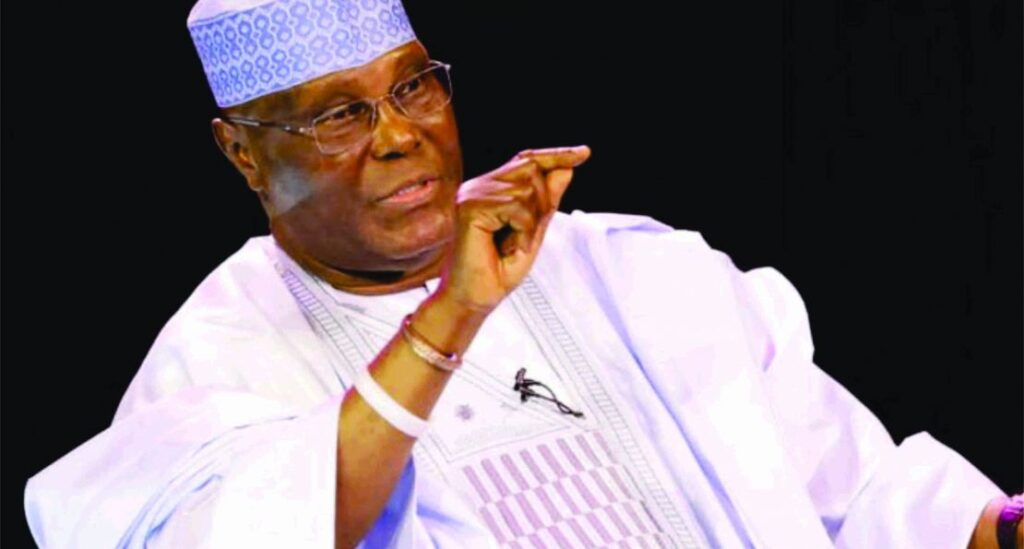
Former Vice President and presidential candidate of the African Democratic Congress (ADC), Atiku Abubakar, has accused President Bola Tinubu of undermining Nigeria’s democratic system following a court judgment directing the Independent National Electoral Commission (INEC) to register the Nigeria Democratic Congress (NDC) as a political party.
Reacting to the court’s decision in a statement issued on Saturday, Atiku alleged that attempts to prevent the registration of the NDC reflected a broader effort to weaken opposition parties ahead of the 2027 general elections.
According to him, any move aimed at limiting political participation or reducing the number of viable political parties threatens the country’s democratic values and could pave the way for a one-party state.
The former Vice President described the alleged attempt to stop the NDC’s registration through legal means as a disturbing development, arguing that it demonstrates what he believes is the current administration’s determination to suppress political competition.
Atiku maintained that democracy thrives when citizens are free to choose from a broad range of political alternatives, stressing that efforts to restrict such choices undermine electoral credibility and public confidence in governance.
He further stated that recent political developments have heightened concerns about the administration’s commitment to free, fair, and transparent elections.
”Nigerians are now seeing the true colours of President Tinubu, who pretends to be a democrat, but his body language and the sinister activities of his agents contradict his professed commitment to free and fair elections,” Atiku said.
The opposition leader warned that protecting democratic institutions, respecting judicial decisions, and allowing political parties to operate without undue interference remain essential to preserving Nigeria’s constitutional democracy.
The court ruling directing INEC to register the Nigeria Democratic Congress has reignited debate over political inclusion, electoral fairness, and the future of Nigeria’s multiparty democracy as preparations gradually begin for the 2027 general elections.
Political observers believe the judgment could reshape the country’s political landscape by expanding the choices available to voters, while also intensifying discussions over the role of institutions in safeguarding democratic governance.
As political activities gather momentum, attention is expected to remain focused on how INEC implements the court’s directive and how the development influences the evolving dynamics of Nigeria’s opposition politics.