
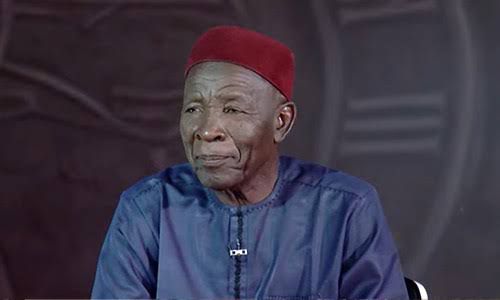
Buba Galadima Defends Obi–Kwankwaso Alliance Ahead of 2027 Elections
A prominent chieftain of the Nigeria Democratic Congress (NDC), Buba Galadima, has defended growing calls for a political alliance between the North and the South-East ahead of Nigeria’s 2027 general election, insisting that such cooperation is rooted in the country’s political history.
Galadima argued that supporters of a Peter Obi–Rabiu Kwankwaso presidential ticket have been subjected to unwarranted criticism by individuals who, according to him, lack an understanding of Nigeria’s political evolution.
Speaking during Arise Television’s Prime Time programme on Wednesday, Galadima responded to recent remarks by the NDC’s vice-presidential candidate, Rabiu Kwankwaso, who advocated stronger political collaboration between northern Nigeria and the South-East as the country prepares for the next general election.
North and South-East Alliance Has Historical Foundation
According to Galadima, political cooperation between the North and the South-East is not a new development but a continuation of a historical partnership that predates Nigeria’s independence.
He recalled that leaders of the Northern People’s Congress (NPC) and the National Council of Nigerian Citizens (NCNC) worked closely together during the struggle for independence and in the early years of the First Republic.
Galadima cited prominent leaders including Sir Ahmadu Bello, Sir Kashim Ibrahim, Dr. Nnamdi Azikiwe, Chief Melford Okilo, and other nationalist figures who collaborated to secure Nigeria’s independence from British colonial rule.
He noted that following independence in 1960, Dr. Nnamdi Azikiwe became Nigeria’s first President while Sir Abubakar Tafawa Balewa, representing the NPC, served as Prime Minister, describing the arrangement as an example of national unity and inclusive governance.
Military Coup Ended First Republic, Says Galadima
Galadima maintained that the political harmony experienced during the First Republic was interrupted by the military coup of 1966.
He argued that civilian political leaders should not bear responsibility for the collapse of Nigeria’s democratic system, insisting that military intervention was responsible for truncating the country’s constitutional government.
According to him, many leading politicians of the era remained committed to democratic governance and would not have supported military rule.
Supporters of Obi–Kwankwaso Ticket Face Criticism
The NDC chieftain lamented that many advocates of an Obi–Kwankwaso presidential ticket have been labelled negatively simply because they support greater political cooperation across regional divides.
Galadima said the criticism often centres on ethnic sentiments, particularly objections to supporting a candidate from the South-East.
He argued that such attacks are misplaced, stressing that Nigeria’s political history demonstrates that national unity has always depended on collaboration among the country’s diverse regions.
Galadima Questions Critics Over Peter Obi
Galadima also questioned those criticising the possibility of Peter Obi emerging as a presidential candidate under a new political arrangement.
He pointed out that Obi previously served as the vice-presidential running mate to former Vice President Atiku Abubakar, noting that Atiku had also selected other politicians from different regions, including Senator Ben Obi and Dr. Ifeanyi Okowa, as running mates in previous elections.
According to Galadima, it is inconsistent for individuals who supported those political alliances in the past to oppose similar arrangements involving Obi today.
Opposition Should Focus on National Issues
Galadima further urged opposition political parties to concentrate on addressing Nigeria’s economic and governance challenges rather than engaging in internal disagreements.
He argued that opposition parties would achieve greater success by presenting a united front instead of allowing regional or ethnic differences to dominate political discourse ahead of the 2027 elections.
Looking Ahead to 2027
As political consultations continue across party lines, discussions surrounding possible alliances and presidential tickets are expected to remain central to Nigeria’s political landscape in the build-up to the 2027 general election.
While no official presidential ticket has been announced, comments from influential political figures such as Buba Galadima and Rabiu Kwankwaso continue to fuel debate over the prospects of broader opposition cooperation and the role regional partnerships may play in shaping the next electoral c inontest.