
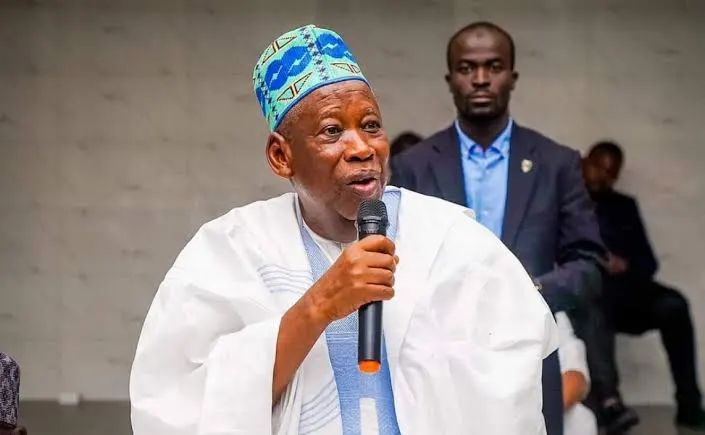
Ganduje Rejects Bandit Negotiations
Warns Against Funding Criminal Groups
Former National Chairman of the All Progressives Congress (APC), Abdullahi Ganduje, has strongly opposed the idea of negotiating with bandits, arguing that such an approach would only strengthen criminal networks and deepen Nigeria’s security challenges.
Speaking during a press conference on Tuesday, Ganduje maintained that engaging armed groups in dialogue while they continue to possess illegal weapons would undermine the country’s security architecture and encourage further criminal activities.
His remarks came in response to comments attributed to the vice-presidential candidate of the Nigeria Democratic Congress (NDC), Rabiu Musa Kwankwaso, who reportedly stated that he and the party’s presidential candidate, Peter Obi, would consider opening dialogue with terrorists if elected in the 2027 general election.
Ganduje Questions Practicality of Negotiating with Armed Bandits
According to Ganduje, Nigeria’s security agencies, including the Nigerian Army, Air Force, Navy, Police, and the Department of State Services (DSS)—already operate within coordinated strategies aimed at tackling insecurity.
He argued that inviting heavily armed bandits to negotiation tables raises serious legal and security concerns.
Ganduje noted that possession of firearms without lawful authorization is a criminal offence in Nigeria, making it difficult to justify formal negotiations with armed groups who openly violate the law.
”Negotiations Could Reward Criminality”
The former Kano State governor warned that previous negotiation efforts have often involved financial incentives, logistics support, motorcycles, or other concessions that unintentionally empower criminal groups.
According to him, providing such benefits creates an enabling environment for bandits to regroup, acquire more sophisticated weapons, and expand their operations.
He argued that ransom payments and other forms of negotiation could increase the financial capacity of kidnappers, allowing them to purchase additional arms and continue attacking communities.
Security Experts Remain Divided
The debate over whether governments should negotiate with armed groups has remained one of Nigeria’s most controversial security issues.
Supporters of dialogue argue that carefully managed negotiations can help secure the release of kidnapped victims, reduce violence in affected communities, and create opportunities for long-term peacebuilding.
However, critics insist that rewarding armed groups with concessions risks encouraging more kidnappings and attacks, as criminal organisations may view negotiations as a profitable strategy.
Nigeria’s Continuing Security Challenge
Banditry, kidnapping, and terrorist activities continue to pose major security concerns across several parts of Nigeria, particularly in the North-West and North-Central regions.
Successive governments have adopted a combination of military operations, intelligence gathering, community engagement, and law enforcement measures to address the evolving threat.
The effectiveness of negotiation versus military action remains a subject of national debate as political parties begin outlining their security strategies ahead of the 2027 general elections.
As discussions continue, Ganduje insists that Nigeria should prioritise strengthening security operations rather than pursuing negotiations that, in his view, could provide financial and logistical advantages to criminal groups.