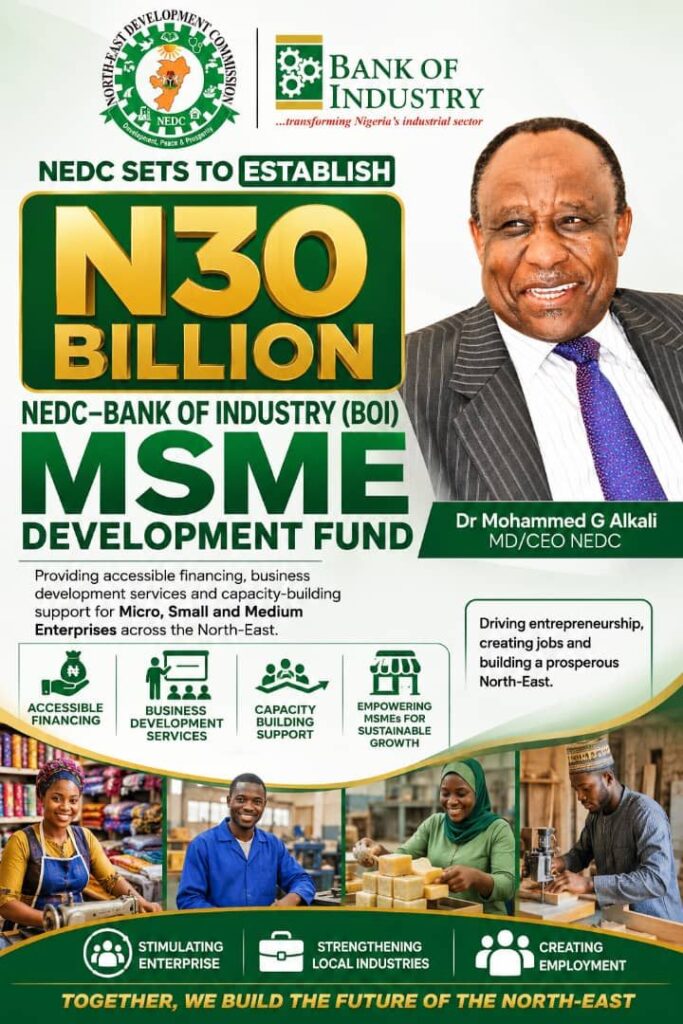
The proposed NEDC–BOI initiative reflects the Commission’s commitment to entrepreneurship, job creation and sustainable economic growth under the leadership of Dr Mohammed G. Alkali.
The North-East Development Commission (NEDC), under the leadership of its Managing Director and Chief Executive Officer, Dr Mohammed G. Alkali, is advancing an economic development agenda that places entrepreneurship, private-sector growth and sustainable livelihoods at the centre of the North-East’s transition from recovery to prosperity.
A major component of this agenda is the proposed ₦30 billion NEDC–Bank of Industry (BOI) Micro, Small and Medium Enterprises (MSME) Development Fund, an initiative designed to strengthen businesses, expand economic opportunities and support youth- and women-owned enterprises across the six states of the North-East.
The proposed fund underscores the importance of providing local entrepreneurs with improved access to finance and business development opportunities, particularly in a region where years of insurgency have disrupted livelihoods, weakened commercial activities and created significant employment challenges.
Under Dr Alkali’s leadership, the Commission continues to pursue a development approach that looks beyond the reconstruction of physical infrastructure to the creation of sustainable economic opportunities capable of improving the living conditions of individuals, families and communities.
Dr Mohammed G. Alkali: Connecting Recovery with Economic Opportunity
The leadership of Dr Mohammed G. Alkali reflects a development philosophy that recognises that rebuilding a region requires more than roads, schools, hospitals and other public infrastructure. It also requires viable businesses, productive citizens, sustainable jobs and an enabling environment for private-sector investment.
As Managing Director and Chief Executive Officer of NEDC, Dr Alkali has overseen the Commission’s development agenda under the North-East Stabilisation and Development Master Plan (NESDMP), which provides a strategic framework for addressing the region’s recovery and long-term development needs.
The proposed ₦30 billion MSME Development Fund aligns with this broader vision by placing small businesses at the heart of regional economic transformation.
Micro, small and medium-sized enterprises are important drivers of economic activity. They provide goods and services, create employment, support household incomes and contribute to the growth of local markets. However, many entrepreneurs face difficulties accessing affordable financing, expanding their operations and acquiring the equipment and resources required to compete effectively.
By prioritising an MSME-focused financing initiative in collaboration with the Bank of Industry, NEDC is directing attention towards one of the fundamental requirements for sustainable regional development: enabling people to build businesses that can support themselves, employ others and contribute to the wider economy.
₦30 Billion Fund to Support Youths and Women
The proposed NEDC–BOI MSME Development Fund is expected to focus particularly on youth- and women-owned enterprises, recognising their potential to contribute to economic recovery, innovation and employment generation.
Across the North-East, entrepreneurs operate in sectors such as agriculture, food processing, transportation, retail, manufacturing, technology, hospitality and other service industries. With appropriate financial support and business development assistance, enterprises in these sectors can expand their activities, improve productivity and reach new markets.
For young people, access to enterprise financing can create an alternative pathway to economic independence, enabling them to turn business ideas into viable commercial ventures.
For women entrepreneurs, improved access to finance can strengthen existing businesses, encourage new investments and increase their participation in the region’s economic activities.
The initiative could also help existing businesses overcome some of the financial constraints that prevent them from acquiring modern equipment, increasing production, improving product quality and employing additional workers.
Its ultimate impact will depend on the final programme guidelines, eligibility criteria, financing terms, geographical distribution and effective implementation. Nevertheless, the proposed fund places enterprise development firmly within the Commission’s wider regional development priorities.
Why the NEDC–BOI Partnership Matters
The proposed collaboration between NEDC and the Bank of Industry is significant because sustainable enterprise development requires more than the availability of money. Businesses also need appropriate financing structures, sound management, market access and the capacity to use financial resources productively.
The Bank of Industry’s role as an institution focused on industrial development and enterprise financing offers a framework for supporting businesses with growth potential.
Through the proposed partnership, the Commission seeks to connect its regional development mandate with enterprise financing, helping to address barriers that prevent businesses from contributing fully to economic growth.
An effective implementation framework would also need to ensure transparency, accountability, fair access and appropriate monitoring so that eligible entrepreneurs across Adamawa, Bauchi, Borno, Gombe, Taraba and Yobe can benefit in accordance with the programme’s approved arrangements.
Such measures would be essential to ensuring that the fund produces measurable results in business expansion, employment generation and local economic development.
A Development Vision Beyond Infrastructure
One of the important dimensions of Dr Alkali’s leadership at NEDC is the emphasis on connecting physical reconstruction with economic recovery and long-term prosperity.
Infrastructure remains essential to regional development. Roads connect communities and markets, electricity supports production, schools build human capital, and healthcare facilities improve access to essential services. However, these investments achieve greater economic value when people have opportunities to use them to improve their livelihoods.
A functional road network, for instance, can help farmers transport produce to markets, while reliable electricity can support small-scale manufacturing and food processing. Similarly, access to enterprise financing can help local businesses take advantage of improved infrastructure and expand their operations.
The proposed ₦30 billion MSME Development Fund therefore fits into a wider development framework in which infrastructure, entrepreneurship, human capital development and private-sector participation complement one another.
This approach is consistent with the central ambition of the North-East Stabilisation and Development Master Plan: moving the region from recovery towards sustainable development.
Commending Dr Mohammed G. Alkali’s Leadership
Dr Mohammed G. Alkali deserves recognition for the attention his leadership has placed on connecting regional reconstruction with economic empowerment and opportunities for ordinary citizens.
The significance of an initiative such as the proposed MSME Development Fund lies not merely in its financial value but in its potential to support people who are working to build businesses, create employment and secure a better future for their families.
A development institution fulfils an important responsibility when it looks beyond immediate reconstruction needs and considers how communities can become economically self-reliant over the long term.
By advancing an agenda that includes enterprise development, youth empowerment and support for women-owned businesses, Dr Alkali’s leadership reflects an understanding that the prosperity of the North-East must ultimately be measured not only by completed projects but also by the economic opportunities available to its people.
His leadership deserves commendation for keeping sustainable development and livelihood restoration within the Commission’s broader priorities. The next important measure will be the effective implementation of proposed initiatives, with transparent processes and verifiable outcomes that demonstrate tangible benefits for businesses and communities.
The successful delivery of the fund could strengthen public confidence in development interventions and demonstrate how strategic partnerships can help address persistent economic challenges across the region.
From Recovery to Prosperity
The North-East’s journey towards lasting prosperity requires coordinated investments in infrastructure, education, healthcare, security, entrepreneurship and productive economic activities.
The proposed ₦30 billion NEDC–BOI MSME Development Fund represents an important element of that wider ambition. By targeting the needs of small businesses and aspiring entrepreneurs, it has the potential to contribute to job creation, enterprise growth and the development of a more resilient regional economy.
Under Dr Mohammed G. Alkali, Managing Director and Chief Executive Officer of NEDC, the Commission’s development agenda continues to emphasise the importance of building a future in which reconstruction translates into sustainable opportunities for the people of the North-East.
Ultimately, the true measure of the initiative will be the businesses it helps to establish, the enterprises it enables to expand, the jobs it supports and the livelihoods it helps to sustain.
From recovery to prosperity, empowering local businesses is an investment in the future of the North-East. The proposed ₦30 billion MSME Development Fund offers an opportunity to advance that objective, while Dr Alkali’s leadership provides the strategic direction through which the Commission seeks to connect regional development with lasting economic progress.