
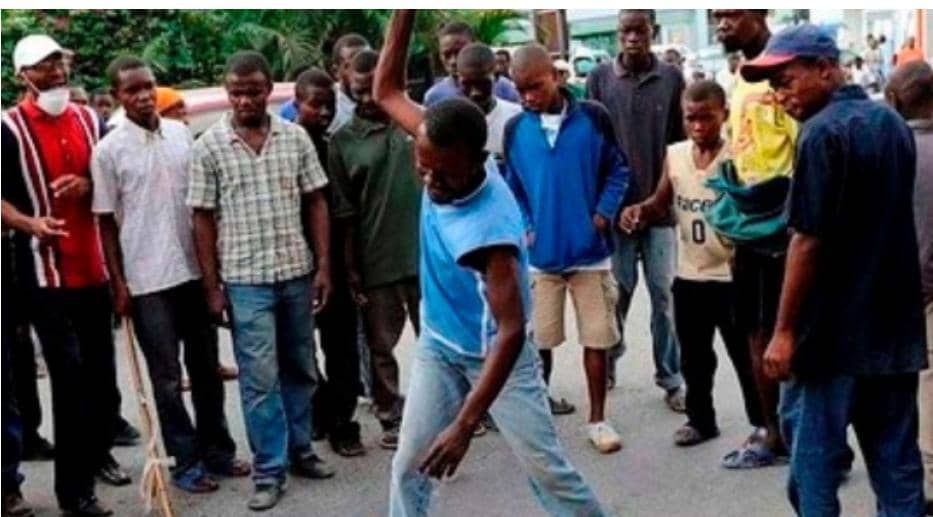
Nigeria is facing growing concern over the resurgence of mob justice, commonly known as jungle justice, as incidents of citizens taking the law into their own hands continue to generate fear and outrage across the country.
From allegations of theft and fraud to accusations of kidnapping, witchcraft and blasphemy, people have increasingly been subjected to violent attacks based on accusations that have not been properly investigated. In some cases, innocent people have lost their lives before the truth about the allegations could emerge.
The trend raises serious questions about public safety, confidence in law enforcement institutions and respect for the rule of law.
A dangerous alternative to justice
Jungle justice occurs when individuals or groups assume the role of investigators, prosecutors and judges and impose punishment on people suspected of committing offences.
While public anger over crime is understandable, mob punishment creates another form of insecurity. A person accused of a crime remains entitled to investigation, legal representation and a fair hearing before a competent court.
Once a crowd assumes that an accusation is proof of guilt, there is little opportunity for evidence to correct a false narrative.
This is particularly dangerous in an era of social media, where rumours, unverified allegations and short video clips can spread rapidly and provoke public outrage before authorities have established the facts.
Innocent people can become victims
One of the most disturbing dimensions of mob violence is that an accusation can sometimes be based on mistaken identity, misinformation or a simple misunderstanding.
Recent incidents reported across different parts of Nigeria demonstrate how quickly suspicion can turn into violence.
In some cases, people have been accused of stealing phones, motorcycles or money transfers. Others have been wrongly suspected of kidnapping or other serious offences.
The consequences can be devastating. A person may suffer serious physical injuries, lose their life or have their reputation permanently damaged even when subsequent investigations establish that the original allegation was false.
The danger is therefore not limited to criminals escaping justice. It also extends to ordinary citizens who may find themselves in the wrong place at the wrong time.
Blasphemy allegations require particular caution
Allegations involving religion are especially sensitive because they can generate strong emotions and rapidly mobilise crowds.
However, religious sensitivity cannot justify violence or extrajudicial punishment. Where an allegation of blasphemy or any other offence arises, the appropriate response is to report it to the relevant authorities and allow the law to take its course.
A rumour should never become a death sentence.
The killing of a person based solely on an allegation ultimately undermines both justice and social stability. It also creates the possibility that genuine facts may never be established because the accused person is no longer alive to respond to the allegation.
Why is mob justice gaining ground?
There is no single explanation for the persistence of jungle justice in Nigeria. The problem appears to be connected to several deeper social and institutional challenges.
1. Declining confidence in institutions
When citizens believe that criminals can escape prosecution or that cases can remain unresolved for years, confidence in formal justice mechanisms can decline.
Some people consequently begin to see immediate punishment as the only effective response to crime.
That perception is dangerous because it creates a cycle in which distrust of institutions produces illegal violence, while the violence itself further weakens public confidence in the justice system.
2. Delays in the justice system
Justice delayed can create frustration among victims and their families.
When criminal cases take years to conclude, witnesses become discouraged, evidence may become difficult to obtain and victims can feel abandoned.
Improving the speed and effectiveness of criminal investigations and prosecutions is therefore an important part of addressing the conditions that allow mob justice to flourish.
3. Fear of crime
Nigeria continues to face serious security challenges in different parts of the country. Kidnapping, robbery, fraud and other crimes have contributed to a climate of fear.
In such an environment, an unusual person or suspicious activity can quickly attract attention.
But fear can also produce dangerous mistakes.
A person who behaves unusually, rides a new motorcycle, enters an unfamiliar neighbourhood or is accused of making a questionable bank transfer should not automatically be considered a criminal.
Suspicion must never be treated as evidence.
4. Social media and instant accusations
The spread of smartphones and social media has changed the way information travels.
A claim can reach thousands of people within minutes without anyone establishing whether it is true.
Videos of alleged criminals are sometimes circulated before investigations are completed. In some cases, the recording itself becomes part of the humiliation of the accused.
This creates a serious challenge for responsible journalism and digital citizenship. Citizens should understand that sharing an unverified allegation can have consequences for another person’s safety and reputation.
The human cost of mob violence
The consequences of jungle justice go far beyond the immediate physical attack.
Families can lose breadwinners, children can lose parents and communities can be left traumatised.
There is also a wider economic cost. Businesses may become reluctant to operate in areas where violence can erupt suddenly. Citizens may become afraid to travel through certain communities, while innocent people can suffer reputational damage from allegations that spread online.
Perhaps most importantly, mob justice weakens the principle that every person deserves a fair opportunity to answer allegations made against them.
Once that principle is abandoned, nobody is completely safe.
Security agencies have a critical responsibility
The police and other security agencies have a central role to play in preventing mob violence.
Where crowds attempt to seize a suspect, security personnel must protect the person and prevent unlawful attacks while maintaining public order.
At the same time, allegations of police officers handing suspects over to angry mobs, where established, should be investigated thoroughly.
Law enforcement officers are expected to uphold the law, including when public pressure is intense.
Accountability is therefore essential. Officers who facilitate extrajudicial killings should not be shielded from investigation, just as citizens who participate in mob killings should face the consequences provided by law.
Traditional and religious leaders can help
Community leaders, traditional rulers and religious authorities also have an important role in discouraging mob violence.
Their influence can be particularly valuable during incidents involving allegations of blasphemy, kidnapping or other emotionally charged offences.
Rather than encouraging confrontation, influential community figures can help calm tensions, encourage residents to contact security agencies and remind citizens that punishment belongs to lawful institutions.
Public education should also emphasise that protecting human life is a responsibility shared by the entire community.
Citizens must resist the temptation to become judge and executioner
The fight against crime requires collective responsibility, but that responsibility does not include punishing suspects outside the law.
A citizen who witnesses a crime should report it.
A person who has evidence should provide it to investigators.
A victim should pursue lawful remedies.
A witness should cooperate with investigators and prosecutors.
But nobody should assume the authority to determine guilt and impose punishment through violence.
This distinction is crucial.
A society cannot build sustainable security by replacing criminality with another form of criminality.
Rebuilding trust in justice
Addressing jungle justice requires more than condemning mobs after people have been killed. The country must tackle the conditions that allow the practice to persist.
This means strengthening criminal investigations, improving police responsiveness, reducing unnecessary delays in court proceedings, protecting witnesses, improving forensic capacity and ensuring that credible cases are prosecuted effectively.
It also requires transparency when investigations fail and accountability when public officials abuse their authority.
Citizens are more likely to trust formal institutions when they can see that complaints are taken seriously and that powerful individuals are not automatically protected from the consequences of their actions.
A collective responsibility
The fight against jungle justice ultimately requires cooperation between government institutions, security agencies, traditional authorities, religious leaders, civil society organisations, journalists and ordinary citizens.
The media also has a responsibility to avoid presenting unverified allegations as established facts. Responsible reporting can help prevent rumours from becoming triggers for violence.
Citizens, meanwhile, must learn to pause before reacting to accusations circulating on social media or in crowded public spaces.
A few minutes of restraint can mean the difference between establishing the truth and destroying an innocent life.
Conclusion
Nigeria cannot defeat insecurity by abandoning the rule of law.
The anger created by crime is real, and victims deserve justice. But justice must be based on evidence, investigation and due process rather than the size or anger of a crowd.
Jungle justice does not merely punish alleged criminals. It can kill innocent people, deepen public fear, damage communities and weaken confidence in the institutions responsible for protecting society.
The long-term solution lies in building a justice system that citizens can trust, security agencies that respond professionally, courts that deliver timely justice and communities that refuse to turn rumours into death sentences.
The choice before Nigeria is clear: strengthen the rule of law or allow mob justice to become an increasingly accepted substitute for it. A safer country requires the former.