
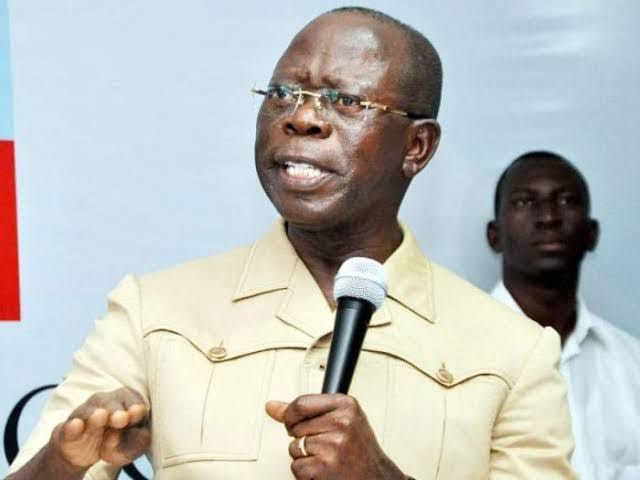
Oshiomhole Challenges Amaechi’s Role in Buhari’s 2015 Election Victory
Former Edo State Governor and Senator representing Edo North, Adams Oshiomhole, has dismissed claims by former Minister of Transportation, Rotimi Amaechi, that he was the key figure responsible for the election of former President Muhammadu Buhari in 2015.
Speaking during an interview on The Mic On Podcast on Sunday, Oshiomhole described Amaechi’s remarks as inaccurate, insisting that the former Rivers State governor was unable to vote for Buhari during the 2015 presidential election due to the political situation in Rivers State at the time.
Oshiomhole Disputes Amaechi’s Account
According to Oshiomhole, Amaechi, who served as the Director-General of Buhari’s presidential campaign, faced intense political opposition from his successor, Nyesom Wike, during the election period.
The senator alleged that Amaechi instructed his supporters in Rivers State to boycott the polls, a decision he said undermined the former minister’s claim of being the architect of Buhari’s victory.
“Amaechi lied that he made Buhari president. Amaechi was not able to vote for Buhari in 2015 because he unwisely directed the people of Rivers State to boycott the polls as he was overwhelmed by the forces of Wike,” Oshiomhole stated.
He further argued that political victories, especially at the national level, are rarely the achievement of a single individual but rather the result of collective efforts by party leaders, campaign teams, and millions of voters.
Amaechi’s Earlier Remarks Spark Debate
The controversy began after Amaechi, now associated with the African Democratic Congress (ADC), claimed during an interview on Arise Television that he played a more significant role than President Bola Tinubu in Buhari’s emergence as president in 2015.
Amaechi maintained that his leadership of the Buhari Campaign Organisation was instrumental to the success of the then-opposition coalition that defeated the ruling Peoples Democratic Party (PDP).
His comments have generated widespread reactions across Nigeria’s political landscape, with supporters and critics offering differing interpretations of the events leading to Buhari’s historic victory.
Renewed Political Rivalry
Political observers believe the exchange reflects ongoing rivalries among key figures who were part of the coalition that brought Buhari to power. The debate also highlights continuing efforts by prominent politicians to define their roles in one of Nigeria’s most significant democratic transitions.
As discussions continue, analysts note that the 2015 election was shaped by a combination of factors, including strategic political alliances, public demand for change, grassroots mobilization, and the collective efforts of numerous stakeholders within the then-opposition movement.
Looking Ahead
The disagreement between Oshiomhole and Amaechi adds another chapter to the evolving political narratives surrounding the 2015 presidential election. With both politicians remaining influential voices in national affairs, their differing accounts are likely to fuel further debate over the legacy of Buhari’s rise to power and the individuals who contributed to it.
.