
From Recovery to Prosperity Through the 11 Pillars of the North-East Stabilisation and Development Master Plan
By Ibrahim Musa Mustapha
For more than a decade, the North-East region of Nigeria has faced the difficult task of rebuilding communities, restoring livelihoods and creating new opportunities following years of insecurity, displacement and economic disruption.
Today, however, a new development narrative is gradually emerging — one that seeks to move the region beyond reconstruction and recovery towards sustainable prosperity.
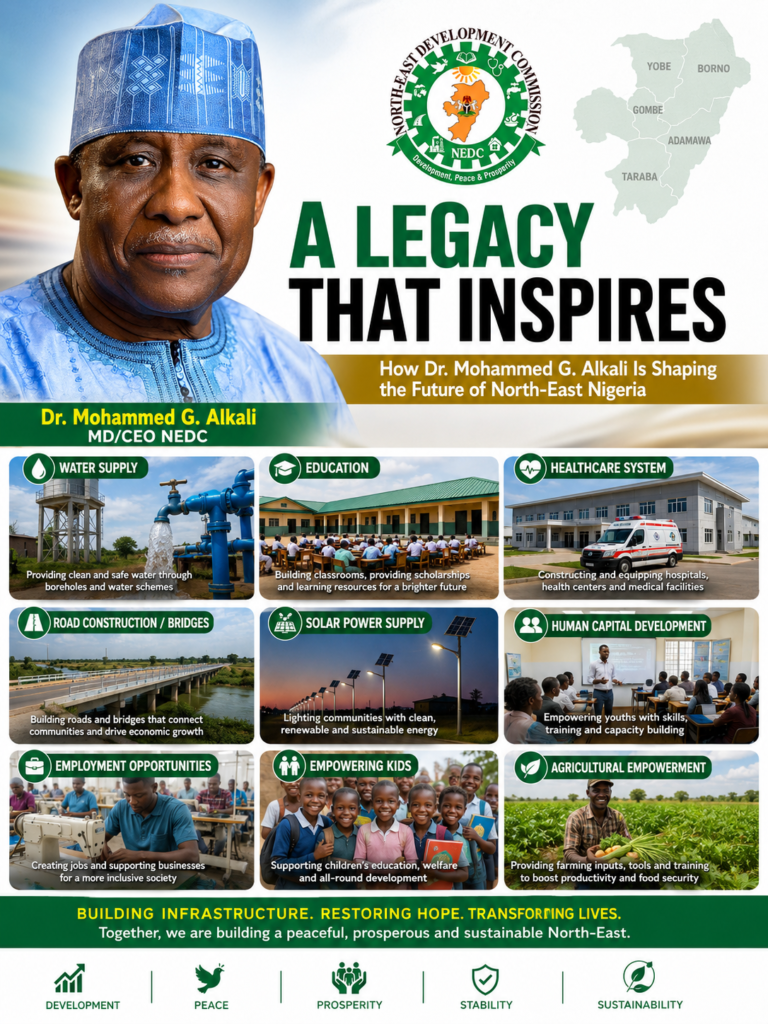
At the centre of this transformation is the North-East Development Commission (NEDC), under the leadership of its Managing Director and Chief Executive Officer, Dr. Mohammed G. Alkali, whose administration has placed strategic planning, human capital development, infrastructure renewal and economic empowerment at the heart of regional development.
The Commission’s long-term development direction is anchored on the North-East Stabilisation and Development Master Plan (NESDMP), a comprehensive framework designed to provide a coordinated pathway for rebuilding the region and positioning it for sustainable economic growth.
The Master Plan is built around 11 strategic pillars, reflecting the understanding that lasting development cannot be achieved through infrastructure alone. It requires peace, productive citizens, education, healthcare, agriculture, industrialisation, trade, environmental protection, connectivity and opportunities for people to thrive.
The emerging philosophy is therefore clear: the North-East must move from recovery to prosperity.
From Reconstruction to a Development Vision
Under Dr. Alkali’s leadership, NEDC’s interventions have increasingly gone beyond responding to immediate humanitarian and post-conflict needs.
The focus is shifting towards building systems and opportunities that can sustain economic growth for generations.
The construction of roads, bridges, schools, hospitals, water schemes and energy infrastructure remains important. But equally significant are programmes aimed at empowering farmers, supporting entrepreneurs, developing young people, improving healthcare, expanding access to education and creating an environment where businesses can flourish.
This integrated approach is what gives the NESDMP its strategic importance.
Rather than treating development challenges in isolation, the Master Plan brings them together under a common regional vision.
The 11 Pillars Driving the Journey From Recovery to Prosperity
- A Peaceful Society
Development cannot thrive without peace and stability.
The first foundation of the NESDMP is therefore the creation of a peaceful and secure society where citizens can return to their communities, rebuild their businesses, educate their children and participate fully in economic activities.
The Commission’s development interventions complement broader government efforts to restore confidence and rebuild communities affected by conflict.
- Leadership in Agriculture
Agriculture remains one of the strongest economic foundations of the North-East.
With millions of people depending directly or indirectly on farming, the NESDMP places agriculture at the centre of economic transformation.
NEDC’s interventions in agricultural empowerment, improved inputs, irrigation, mechanisation, livestock development and capacity building are aimed at transforming farmers from subsistence producers into more productive participants in the regional economy.
The objective is not simply to distribute agricultural inputs, but to create a more productive agricultural ecosystem capable of improving food security, generating employment and supporting agro-industrial development.
- Healthy Citizens
A prosperous region requires a healthy population.
NEDC has therefore continued to invest in healthcare infrastructure, including hospitals, medical centres, accident and emergency facilities, primary healthcare facilities and the provision of medical equipment.
Healthcare interventions, including support for maternal and child health and medical outreach programmes, are particularly important in underserved communities.
The development of modern healthcare infrastructure is ultimately an investment in the productivity and wellbeing of the people of the North-East.
- Purposeful Infrastructure
Infrastructure provides the backbone for economic transformation.
Across the six states of the region, NEDC has invested in roads, bridges, water supply systems, schools, healthcare facilities, electricity projects and other critical infrastructure.
Solar-powered boreholes and motorised water schemes are improving access to clean water, while road and bridge projects are reconnecting communities with markets, schools, hospitals and administrative centres.
The objective is to create infrastructure that serves a clear economic and social purpose — infrastructure that connects people, facilitates commerce and opens previously inaccessible communities to development.
- Productive Entrepreneurs
A prosperous North-East cannot depend entirely on government employment.
The region requires a strong private sector driven by entrepreneurs, small businesses and innovative young people.
Through entrepreneurship programmes, skills acquisition, vocational training and business-support initiatives, NEDC is working to equip citizens with the tools required to create businesses and sustainable sources of income.
This pillar recognises that the region’s young population represents an enormous economic asset when provided with the right skills, opportunities and enabling environment.
- An Educated Populace
Education remains one of the most powerful instruments for breaking the cycle of poverty.
NEDC has invested in school construction and rehabilitation, modern classrooms, ICT facilities, learning materials, scholarships and teacher development programmes.
The goal is to ensure that children and young people across the region have access to quality education and the skills necessary to participate in a modern economy.
The future prosperity of the North-East will ultimately depend on the quality of its human capital.
- A Protected Environment
Environmental sustainability is becoming increasingly important to the future of the region.
The NESDMP recognises the need to protect natural resources, address environmental degradation and promote sustainable development practices.
Tree planting, renewable energy initiatives and environmentally responsible development are part of the broader effort to create communities that can grow economically without compromising the environment for future generations.
- Industrialisation
The transition from recovery to prosperity requires the North-East to produce, process and add value to its own resources.
Industrialisation can create jobs, stimulate investment, expand markets and reduce dependence on imported products.
The NESDMP therefore provides a framework for encouraging industries capable of leveraging the region’s agricultural, mineral, human and other economic resources.
The long-term ambition is to move the region from being primarily a producer of raw materials to becoming a centre of processing, manufacturing and value addition.
- Flourishing Trade
The North-East occupies a strategic position linking Nigeria with neighbouring countries in the Lake Chad and Sahel regions.
A stronger trading environment can therefore unlock enormous economic opportunities.
Improved roads, electricity, markets, entrepreneurship and regional connectivity can stimulate commerce and make the North-East a more attractive destination for investors and businesses.
The NESDMP seeks to harness this strategic advantage by creating conditions for trade to flourish within the region and beyond.
- A Memorable Experience
Development is ultimately about people and the quality of life they experience.
The NESDMP’s vision extends beyond economic statistics to creating communities where citizens can live with dignity, access essential services, enjoy recreational opportunities and experience the benefits of development.
This pillar reflects the broader aspiration of transforming the North-East into a region where people do not merely survive but can live, work, invest and raise their families with confidence in the future.
- A Connected Region
Connectivity is critical to modern economic development.
A connected North-East means better roads, stronger digital infrastructure, reliable energy, efficient transportation and improved links between communities, markets and institutions.
NEDC’s infrastructure and connectivity initiatives are therefore essential to creating an integrated regional economy in which goods, services, people and ideas can move more efficiently.
Lighting the Path With Renewable Energy
Energy remains one of the greatest drivers of economic development.
Recognising this reality, NEDC has invested in solar-powered streetlights, solar boreholes, mini-grid initiatives and other renewable-energy projects across communities in the region.
These interventions are improving security, supporting businesses, extending economic activities beyond daylight hours and reducing dependence on unreliable electricity sources.
The Commission’s growing interest in clean energy also demonstrates that the North-East’s development agenda is being designed with the future in mind.
Revolutionising Mobility Through Electric Vehicles
One of the emerging innovations associated with NEDC’s development agenda is the proposed deployment of electric tricycles across the North-East.
The initiative is expected to contribute to improved transportation, create employment opportunities, support youth and women, reduce transportation pressures and encourage cleaner mobility.
Beyond transportation, the initiative demonstrates a broader philosophy: development programmes must respond to contemporary challenges while preparing the region for emerging technologies and economic opportunities.
The electric vehicle initiative therefore fits naturally into the wider vision of a modern, connected and environmentally sustainable North-East.
Investing in People, Not Just Projects
Perhaps one of the most significant features of Dr. Alkali’s leadership is the emphasis on human beings as the ultimate beneficiaries of development.
Roads and buildings are important, but their real value lies in how they improve people’s lives.
A school matters because it educates a child. A hospital matters because it saves lives. A road matters because it connects farmers to markets. A borehole matters because it gives families access to clean water. A skills programme matters because it can help a young person build a sustainable livelihood.
This people-centred philosophy is at the heart of the journey from recovery to prosperity.
From Recovery to Prosperity
The North-East has come a long way.
The region that once dominated national conversations because of conflict and humanitarian challenges is increasingly being positioned for economic renewal.
The transition, however, requires patience, continuity and strategic investment.
The NESDMP provides the roadmap, while NEDC’s interventions provide some of the practical building blocks required to translate that roadmap into reality.
Under Dr. Mohammed G. Alkali, the Commission has demonstrated that regional development must be approached comprehensively — from water to healthcare, agriculture to education, infrastructure to entrepreneurship, renewable energy to transportation.
The ambition is no longer simply to rebuild what was lost.
It is to build something better.
It will also be measured by the number of farmers whose productivity improved, young people who acquired skills, entrepreneurs who created businesses, children who gained access to education, families who obtained clean water and communities that regained confidence in their future.
A Legacy of Hope and Transformation
Dr. Mohammed G. Alkali’s tenure at NEDC is increasingly associated with a development philosophy that seeks to combine reconstruction with long-term economic transformation.
His legacy will not be measured only by the number of roads constructed, schools renovated, hospitals upgraded, boreholes installed or communities connected.
The greatest test of development leadership is whether today’s interventions create opportunities that survive beyond the tenure of the person who initiated them.
That is the significance of the North-East Stabilisation and Development Master Plan.
It is not merely a recovery document. It is a blueprint for a new regional future.
With its 11 pillars providing a comprehensive framework, the North-East has an opportunity to move decisively from recovery to prosperity — from rebuilding communities to building an economy, from addressing the consequences of crisis to unlocking the enormous potential of its people.
And at the centre of this ambitious journey stands the North-East Development Commission, under the leadership of Dr. Mohammed G. Alkali, working towards a future in which the North-East is not defined by its past challenges, but by its resilience, productivity, innovation and prosperity.
The story of the North-East is therefore changing — from recovery to renewal, from renewal to growth, and ultimately from recovery to prosperity.