
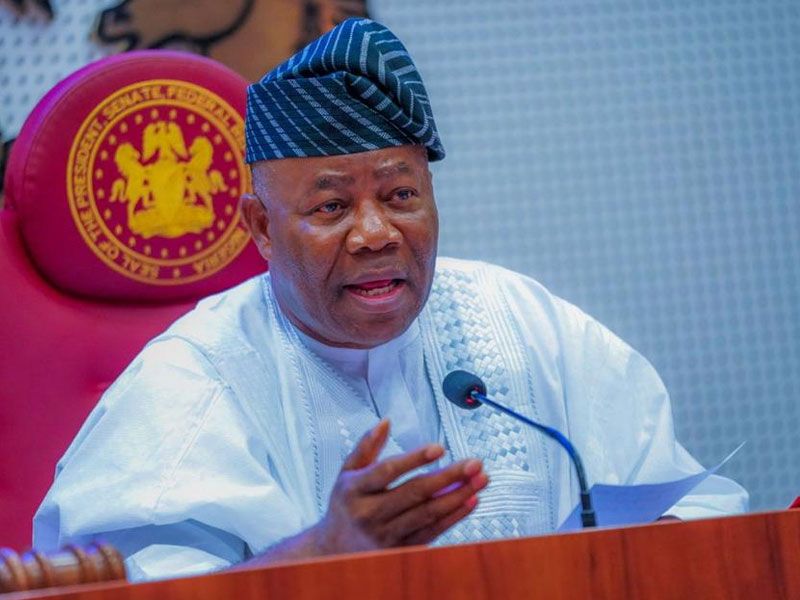
Nigeria’s Senate President, Godswill Akpabio, has attributed the recent surge in insecurity across the country to political tensions ahead of the 2027 general elections, expressing optimism that the situation will significantly improve shortly after the polls.
Akpabio made the remarks on Tuesday during the official launch of the Nigerian Revenue Service Corporate Headquarters in Abuja. According to him, the escalation of insecurity is being driven by individuals and groups seeking political advantage as the election cycle approaches.
“Insecurity is increasing because election is coming, because people don’t know what to do again. Immediately after election, two weeks after election, the insecurity will stop. The insecurity is being sponsored by people,” Akpabio stated.
Political Context and Reactions
The Senate President also used the occasion to commend the administration of Bola Ahmed Tinubu, asserting that the government’s performance has unsettled opposition figures. He suggested that this perceived success has led to intensified political maneuvering, including alleged sponsorship of insecurity.
In a pointed critique, Akpabio referenced internal challenges within opposition parties, particularly alluding to Peter Obi, the Labour Party’s presidential candidate in the 2023 elections. Without naming him directly at first, Akpabio described a scenario in which a candidate who secured millions of votes later distanced himself from the party structure, contributing to what he characterized as disarray within the opposition.
“Opposition is in disarray… someone got six million votes and abandoned the party… and they are blaming the ruling party,” he added.
Security Concerns Remain High
Akpabio’s comments come at a time when Nigeria continues to grapple with multiple security challenges, including insurgency in the North-East, banditry in the North-West, and kidnapping incidents across various regions. While his remarks suggest a politically motivated dimension to insecurity, analysts have often pointed to a combination of socio-economic, governance, and structural factors driving the crisis.
Security experts caution that attributing insecurity solely to electoral politics may oversimplify a complex issue. They emphasize the need for sustained investment in intelligence, policing, and community-based interventions, regardless of the electoral timeline.
Public and Expert Reactions
Reactions to Akpabio’s statement have been mixed. Some political observers view his comments as reflective of the intense rivalry expected ahead of 2027, while others have criticized the remarks as dismissive of the real and ongoing suffering caused by insecurity.
Civil society organizations have called for a more comprehensive approach to addressing security challenges, urging government officials to focus on actionable solutions rather than political rhetoric.
Looking Ahead
As Nigeria moves closer to the next general election cycle, political discourse is expected to intensify. Whether insecurity will indeed decline after the elections, as predicted by Akpabio, remains uncertain. For many Nigerians, the priority continues to be immediate and lasting improvements in safety and stability across the country.
.