
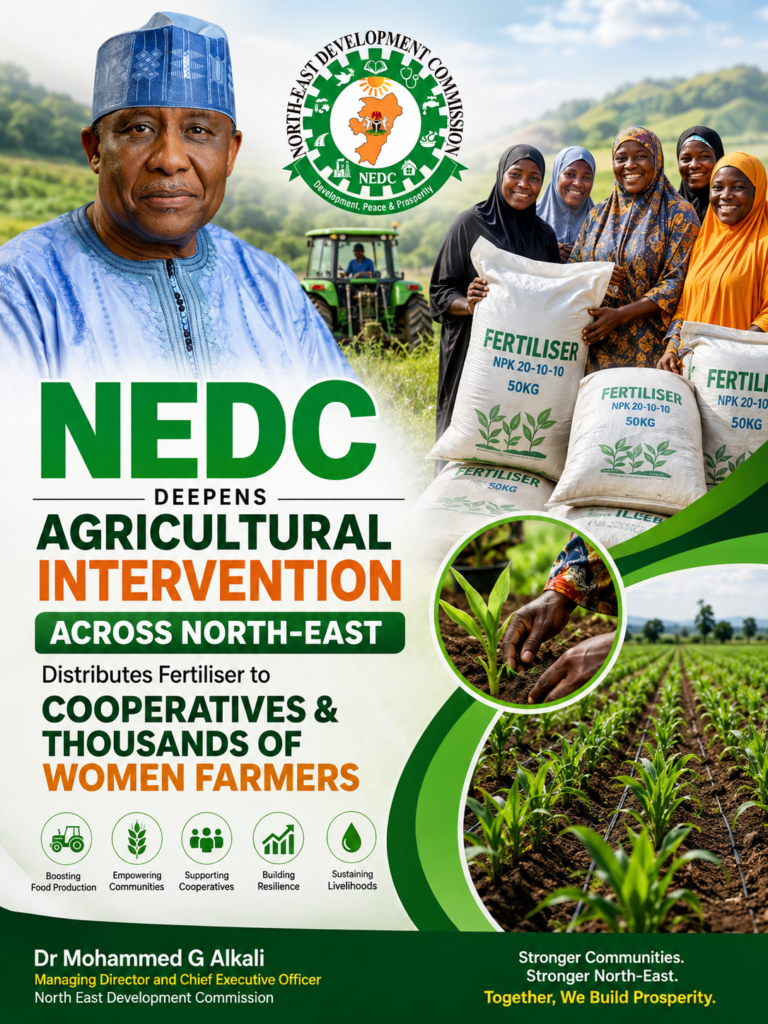
The North East Development Commission (NEDC), under the leadership of its Managing Director and Chief Executive Officer, Dr. Mohammed G. Alkali, has intensified its intervention in the agricultural sector with the distribution of fertiliser and other agricultural inputs to farmers across the six states of the North-East.
The intervention, which covers Adamawa, Bauchi, Borno, Gombe, Taraba and Yobe States, forms part of the Commission’s broader strategy to strengthen food production, support vulnerable farming households and accelerate economic recovery in the region through agriculture.
The latest distribution in Adamawa State, implemented in collaboration with the Adamawa Agricultural Development Programme (ADP), saw fertiliser handed over to 21 cooperative societies across the state for onward distribution to farmers.
The initiative is anchored on the second pillar of the NEDC Master Plan, “Leadership in Agriculture,” which recognises agriculture as a critical pathway to food security, employment generation, poverty reduction and sustainable economic development in the North-East.
Adamawa: Supporting Cooperatives and Smallholder Farmers
While handing over the agricultural inputs in Adamawa, the NEDC State Coordinator, Barr. Khalifa Muhammad Lawan, charged leaders of the beneficiary cooperatives to ensure that the fertiliser reaches genuine farmers, particularly needy and vulnerable members of their communities.
He explained that the intervention was designed to increase crop production, sustain farming activities and reduce the burden created by the rising cost of agricultural inputs.
Barr. Lawan also cautioned beneficiaries against selling, diverting or otherwise misusing the fertiliser, stressing that the inputs were provided to support agricultural production and improve the welfare of farming communities.
Receiving the commodities, the Programme Manager of Adamawa ADP, Hajia Halima Muhammed, expressed appreciation to NEDC for what she described as a timely intervention.
She assured the Commission that the ADP would work closely with NEDC to monitor the distribution and ensure that the fertiliser is judiciously utilised for the purpose for which it was provided.
A Regional Intervention, Not an Isolated Programme
The Adamawa initiative is part of a wider regional agricultural intervention being implemented by NEDC across the six North-East states.
Under Dr. Alkali’s leadership, the Commission has continued to approach agricultural development from a regional perspective, recognising that the challenges facing farmers in the North-East extend beyond individual state boundaries.
The region remains one of Nigeria’s major agricultural belts, with millions of people depending directly or indirectly on farming, livestock production and related value chains for their livelihoods.
Consequently, NEDC’s agricultural interventions are increasingly focused on ensuring that farmers have access to essential inputs while creating conditions for increased productivity and improved household incomes.
The distribution of fertiliser is particularly significant because the cost and availability of farm inputs can determine the ability of smallholder farmers to cultivate sufficient land and achieve meaningful yields.
By supporting farmers with inputs, NEDC is helping to reduce production costs while strengthening the capacity of farming communities to contribute to the region’s food supply.
Reaching Thousands of Women Farmers
A notable component of the Commission’s agricultural intervention is its deliberate focus on women farmers.
Across the North-East, NEDC has also distributed fertiliser to thousands of women in collaboration with the offices of the First Ladies of the six states.
The partnership provides an important platform for reaching women farmers, particularly vulnerable and economically disadvantaged women whose livelihoods depend on agricultural activities.
The initiative reflects NEDC’s recognition of the important role women play in the agricultural economy of the North-East. Women are actively involved in crop production, processing, marketing and other segments of the agricultural value chain, yet many continue to face difficulties accessing productive assets and agricultural inputs.
Through collaboration with the offices of the North-East First Ladies, NEDC has been able to extend the reach of its agricultural support to women at the grassroots, reinforcing the Commission’s commitment to inclusive development.
The intervention therefore goes beyond the distribution of fertiliser. It represents an effort to strengthen household livelihoods, promote women’s economic participation and ensure that the benefits of agricultural development reach vulnerable communities.
Agriculture as an Instrument for Regional Recovery
For a region that has experienced years of insecurity, displacement, disruption of livelihoods and economic hardship, agriculture occupies a strategic position in the North-East’s recovery and development agenda.
The sector has the capacity to generate employment for young people, create opportunities for women, support local businesses and contribute significantly to food security.
This is why NEDC’s agricultural intervention under the leadership of Dr. Mohammed G. Alkali is closely connected to the Commission’s wider mandate of moving the North-East from recovery towards sustainable prosperity.
Rather than treating agriculture simply as the provision of farm inputs, the Commission’s approach places agricultural development within a broader framework of economic empowerment and regional transformation.
The provision of fertiliser helps farmers produce more, but increased production can also stimulate demand for transportation, storage, processing, trading and other agricultural services.
In this sense, supporting farmers can create a multiplier effect across rural economies.
Strengthening Partnerships
The collaboration between NEDC and state agricultural development agencies, such as the Adamawa ADP, demonstrates the importance of institutional partnerships in delivering development interventions effectively.
Similarly, the collaboration with the offices of the First Ladies provides an additional mechanism for identifying and reaching vulnerable women who can benefit from agricultural support.
Such partnerships allow NEDC to combine its regional development mandate with the grassroots structures and networks available within the states.
The approach also strengthens monitoring and accountability by giving relevant state institutions and stakeholders a role in ensuring that agricultural inputs reach their intended beneficiaries.
Advancing the “Leadership in Agriculture” Pillar
The continuing fertiliser intervention gives practical expression to the second pillar of the NEDC Master Plan, “Leadership in Agriculture.”
The pillar is built around the understanding that agricultural transformation must be central to the socio-economic development of the North-East.
Under Dr. Mohammed G. Alkali, NEDC has continued to position agriculture as an important component of its development strategy, with interventions aimed at improving production, supporting farmers and strengthening livelihoods.
The emphasis on vulnerable farmers and women is particularly important because inclusive agricultural development ensures that support is not concentrated only among large-scale producers but also reaches smallholder farmers who constitute a significant part of the region’s agricultural workforce.
From Input Support to Food Security
The significance of the fertiliser distribution extends beyond the immediate farming season.
At a time when food security remains a major national concern, increasing the productive capacity of farmers in the North-East can contribute to greater availability of food while strengthening rural household incomes.
If properly utilised, the inputs can help farmers expand cultivation, improve yields and increase the volume of agricultural produce entering local markets.
This, in turn, can support food availability and contribute to the stabilisation of livelihoods in communities across the region.
For NEDC, therefore, the objective is not simply to distribute fertiliser, but to create an enabling environment in which farmers can become more productive and resilient.
A Shared Regional Development Vision
From Adamawa to Borno, Bauchi to Gombe, Taraba to Yobe, the agricultural intervention demonstrates a shared regional development vision anchored on the belief that the North-East can leverage its vast agricultural potential to build a more prosperous future.
The distribution of fertiliser to 21 cooperative societies in Adamawa is consequently one part of a much larger regional effort.
The Commission’s collaboration with state agricultural institutions and the offices of the North-East First Ladies further demonstrates a coordinated approach to reaching farmers and vulnerable women across the region.
Under Dr. Mohammed G. Alkali, NEDC is increasingly linking agricultural support with the broader objectives of food security, poverty reduction, women’s empowerment, employment creation and economic recovery.
Ultimately, the success of these interventions will be measured not only by the quantity of fertiliser distributed, but by the acres cultivated, increased agricultural yields, stronger rural livelihoods, greater participation of women in the agricultural economy and the emergence of more resilient farming communities across the North-East.
The message from the intervention is clear: agriculture is not merely a means of survival for the North-East; it is a strategic foundation for the region’s journey from recovery to prosperity.
A teacher specialise in both irrigation and rainy seasons farming, including aquaculture farming