
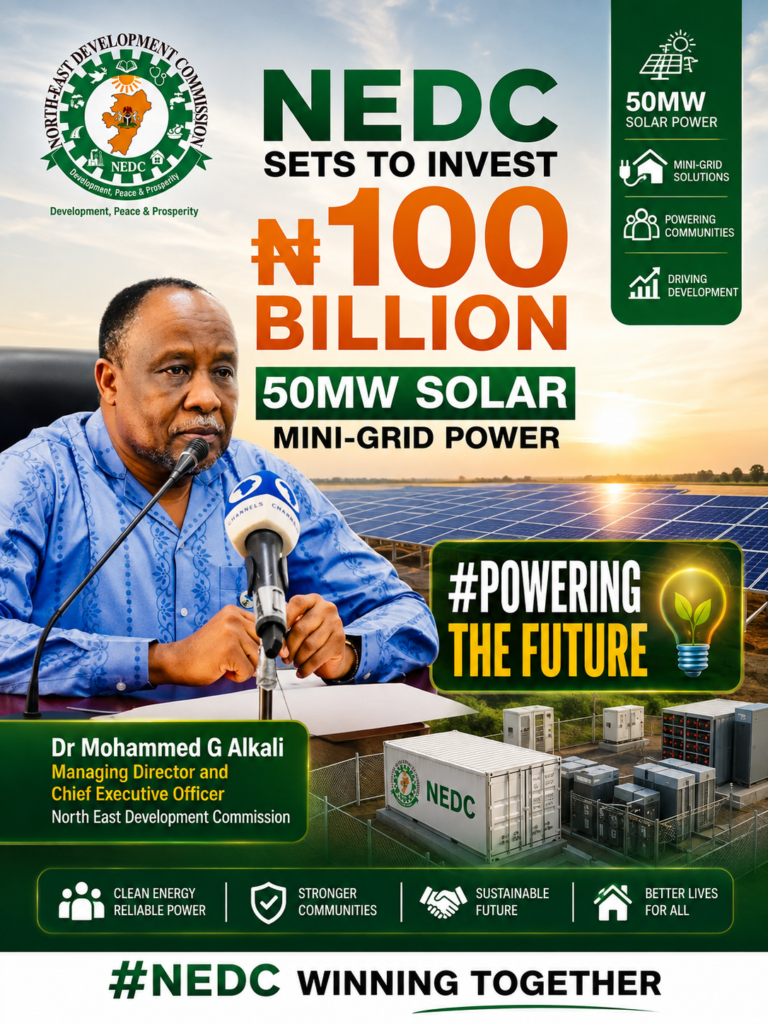
The North East Development Commission (NEDC) has approved a landmark ₦100 billion investment for the deployment of 50 megawatts (MW) of renewable energy through solar mini-grids and distributed energy systems, marking one of the largest clean energy interventions in the region’s history.
The initiative, approved by the Commission’s Governing Board, is aimed at addressing the chronic electricity deficit across the North-East while unlocking new opportunities for economic growth, industrialisation, job creation and improved public services.
The investment forms part of the Commission’s broader strategy to accelerate sustainable development under the North-East Stabilisation and Development Master Plan (NESDMP) and aligns with the Federal Government’s commitment to expanding access to clean and affordable energy.
Tackling One of the Region’s Biggest Development Challenges
Reliable electricity remains one of the most critical factors for economic development. Across the North-East, inadequate power supply has continued to constrain businesses, agricultural processing, healthcare delivery, education and digital innovation.
Recognising this challenge, the NEDC is investing heavily in renewable energy infrastructure that will provide sustainable and decentralised electricity to communities currently underserved by the national grid.
Solar mini-grids have emerged as one of the most practical solutions for rural and semi-urban communities because they can deliver stable electricity without relying entirely on extensive transmission infrastructure.
By expanding renewable energy access, the Commission aims to improve productivity, reduce the cost of doing business and stimulate inclusive economic growth throughout the six North-East states.
Building on the Success of the Light Up the North-East Project
The new investment builds on the achievements of the Commission’s Light Up the North-East Project, which has already delivered significant improvements in public infrastructure.
Under the programme, more than 100,000 solar-powered street lights have been installed across towns and communities in the region.
The project has contributed to:
Improved public safety through better street lighting.
Extended business and commercial activities after dark.
Enhanced security in residential and commercial areas.
Reduced dependence on diesel-powered generators.
Lower carbon emissions through the use of clean energy.
The success of the initiative has demonstrated the transformative role renewable energy can play in supporting sustainable development across the North-East.
Addressing the Region’s Electricity Access Gap
The decision to expand renewable energy investment is also driven by the significant electricity access gap facing the region.
Nigeria currently records an estimated 58 percent national electrification rate, meaning approximately 42 percent of the country’s population still lacks access to electricity.
The situation is considerably more challenging in the North-East, where only 39 percent of residents have access to electricity, leaving 61 percent of the population without reliable power supply.
This energy deficit continues to limit:
Industrial development.
Agricultural value addition and food processing.
Quality healthcare services.
Educational opportunities.
Digital inclusion.
Private sector investment.
Small and medium-sized enterprise (SME) growth.
By investing in solar mini-grids, the NEDC aims to bridge this gap and provide reliable electricity to communities that have remained underserved for decades.
Economic Benefits of the Investment
Access to dependable electricity is widely recognised as a key driver of economic transformation.
The planned 50MW renewable energy programme is expected to stimulate local economies by supporting businesses, encouraging entrepreneurship and creating employment opportunities across multiple sectors.
Reliable electricity will enable manufacturers and small businesses to reduce operational costs associated with diesel generators while increasing productivity.
Farmers and agro-processing enterprises will also benefit from improved energy access for storage, irrigation and value-added processing, reducing post-harvest losses and improving food security.
Healthcare facilities are expected to provide more reliable services through uninterrupted electricity for medical equipment, laboratories, vaccine storage and emergency care.
Schools and educational institutions will equally benefit from improved learning environments, digital classrooms and enhanced access to information technology.
Supporting Sustainable Development
Beyond improving electricity supply, the project reinforces Nigeria’s transition towards cleaner and more sustainable sources of energy.
Solar mini-grids reduce greenhouse gas emissions, minimise environmental pollution and provide long-term energy security for communities that are difficult to connect to the national grid.
The initiative also supports global efforts to promote climate resilience while advancing sustainable economic development through renewable energy.
A New Chapter for the North-East
The approval of the ₦100 billion 50MW Solar Mini-Grid Power Programme represents another significant milestone in the North East Development Commission’s commitment to rebuilding and transforming the region.
By combining infrastructure development with renewable energy investment, the Commission is laying the foundation for stronger local economies, increased private sector participation and improved quality of life for millions of people.
As implementation progresses, the initiative is expected to accelerate industrial growth, expand access to essential services and position the North-East as a leading example of how renewable energy can drive inclusive and sustainable development.
Under the leadership of Dr Mohammed G. Alkali, Managing Director and Chief Executive Officer, the North East Development Commission continues to pursue strategic investments designed to move the region beyond recovery towards long-term prosperity.
#POWERING THE FUTURE
#NEDCWinningTogether