
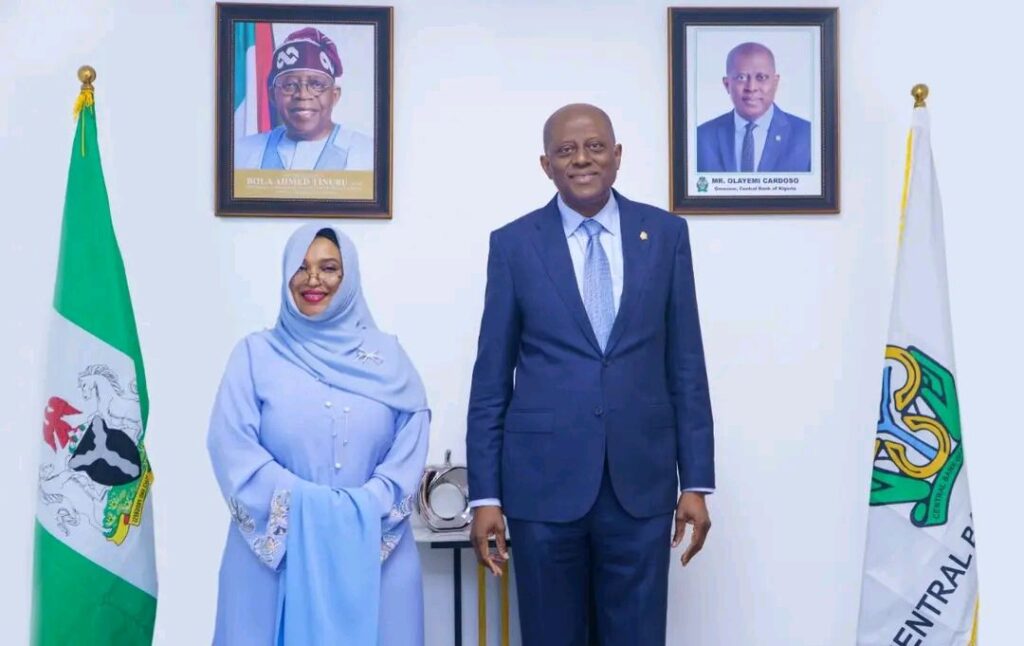
The Governor of the Central Bank of Nigeria (CBN), Olayemi Cardoso, on Thursday, April 23, 2026, hosted the Chief Executive Officer of the Nigeria Financial Intelligence Unit (NFIU), Hafsat Abubakar Bakari, at the CBN Headquarters in Abuja, in a strategic move aimed at reinforcing Nigeria’s financial system against illicit activities.
The high-level engagement underscores the growing collaboration between the CBN and NFIU to deepen financial intelligence sharing, improve regulatory alignment, and ensure the sustained implementation of Nigeria’s Anti-Money Laundering and Countering the Financing of Terrorism (AML/CFT) framework.
Strengthening Financial Intelligence in Nigeria
During the meeting, both leaders emphasized the importance of inter-agency cooperation in tackling financial crimes such as money laundering, terrorism financing, and illicit financial flows. With Nigeria’s financial ecosystem becoming increasingly complex, the need for coordinated intelligence gathering and regulatory enforcement has never been more critical.
Mr. Cardoso reiterated the CBN’s commitment to maintaining a transparent and resilient banking system, noting that enhanced collaboration with the NFIU is essential to safeguarding the integrity of Nigeria’s financial institutions. He stressed that robust financial intelligence mechanisms are key to identifying suspicious transactions and preventing systemic risks.
Hafsat Bakari, on her part, highlighted the NFIU’s ongoing efforts to strengthen data analytics, intelligence dissemination, and compliance monitoring across financial institutions. She noted that effective cooperation with regulators like the CBN is vital to ensuring that financial institutions adhere strictly to AML/CFT regulations.
Boosting Regulatory Coordination and Compliance
The meeting also focused on improving regulatory coordination between both institutions. Industry observers note that closer alignment between the CBN and NFIU could lead to more efficient supervision of banks, fintech companies, and other financial service providers operating within Nigeria.
Experts believe that such partnerships are critical in addressing gaps in compliance and ensuring that Nigeria meets international standards set by global bodies like the Financial Action Task Force (FATF).
Both agencies reaffirmed their commitment to continuous engagement, capacity building, and policy reforms aimed at strengthening Nigeria’s position in the global financial system.
Enhancing Nigeria’s AML/CFT Framework
Nigeria has made significant progress in recent years in improving its AML/CFT framework, but challenges remain. The collaboration between the CBN and NFIU is expected to drive further improvements, particularly in areas such as:
Detection and reporting of suspicious financial activities
Enforcement of compliance among financial institutions
Strengthening of risk-based supervision
Use of technology in financial intelligence operations
Analysts say that sustained efforts in these areas will not only reduce financial crime but also boost investor confidence and enhance Nigeria’s reputation in the international financial community.
Implications for Nigeria’s Financial Sector
The outcome of this engagement is expected to have far-reaching implications for Nigeria’s banking and financial services sector. By strengthening financial intelligence and regulatory oversight, the CBN and NFIU aim to create a more secure and transparent financial environment.
This development aligns with broader economic reforms aimed at stabilizing the financial system, improving governance, and attracting foreign investment.