
By Ibrahim Musa Mustapha
The story of the North-East Development Commission (NEDC) in recent years is increasingly defined by a transition from emergency recovery to long-term regional transformation. At the centre of this evolving development agenda is the Managing Director and Chief Executive Officer of the Commission, Dr Mohammed G. Alkali, whose leadership has placed greater emphasis on infrastructure, human capital, enterprise development, technology, clean energy and sustainable economic growth across the six states of the North-East.
The North-East comprises Adamawa, Bauchi, Borno, Gombe, Taraba and Yobe. The region faces complex development challenges resulting from years of insecurity, displacement, damaged infrastructure, unemployment and weak economic opportunities. The NEDC was established to coordinate reconstruction, rehabilitation and development interventions in the region, and its long-term development framework is anchored on the North-East Stabilisation and Development Master Plan (NESDMP).
Under Dr Alkali’s leadership, the Commission’s approach has increasingly moved beyond simply rebuilding what was destroyed. The broader objective is to build systems that can create lasting prosperity.
From Recovery to Prosperity
One of the defining features of Dr Alkali’s leadership is the emphasis on connecting physical infrastructure with economic opportunity. Roads, bridges, health facilities, schools, water projects, renewable-energy interventions and other infrastructure are not viewed merely as isolated projects, but as components of a larger regional development strategy.
Available profiles of his tenure credit NEDC with major interventions including thousands of housing units, reconstruction of bridges, road construction and the installation of more than 50,000 solar-powered streetlights through the “Light Up the North-East” initiative.
The significance of these interventions is that infrastructure can become an enabler of commerce, education, healthcare, agriculture and investment. A good road can connect farmers to markets. Electricity can support businesses after sunset. A functional health facility can reduce the distance people travel for treatment. Educational infrastructure can expand opportunities for young people.
This is the development philosophy that gives greater meaning to the idea of “NEDC Winning Together.”
Electric Vehicles: A New Economic Frontier
Perhaps one of the most visible examples of the Commission’s forward-looking agenda is its electric vehicle programme.
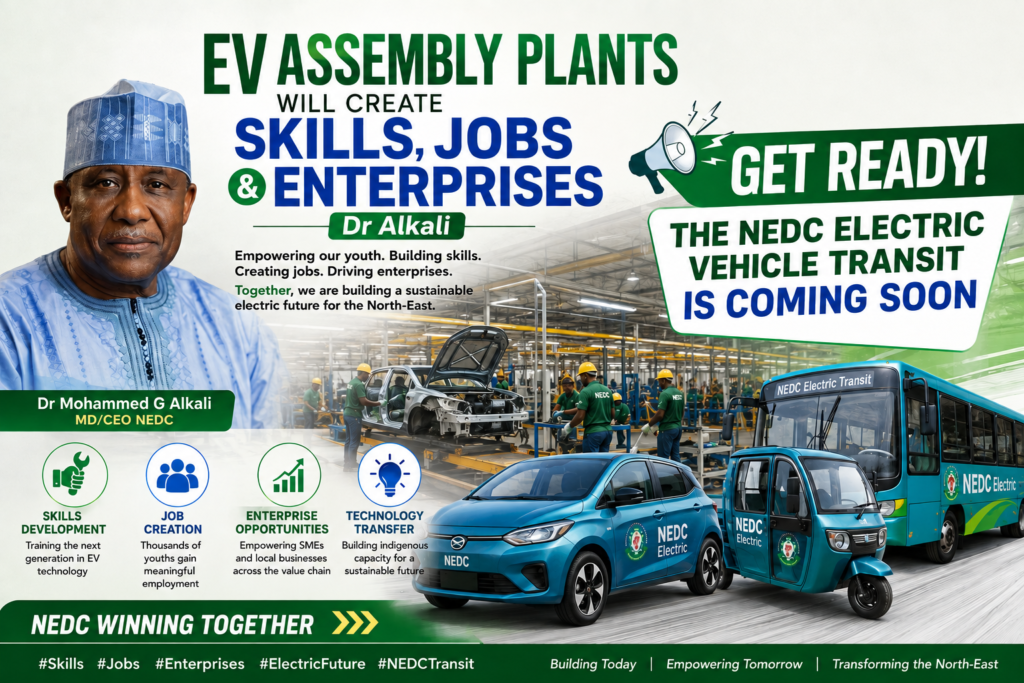
In 2024, President Bola Ahmed Tinubu approved NEDC’s framework for deploying electric vehicles across the North-East. Dr Alkali explained that the Commission had assessed the relative advantages of compressed natural gas and electric mobility for the region before concluding that electric vehicles offered significant advantages. The planned mobility system includes electric buses, sedan taxis and modified electric tricycles.
The programme is important not simply because it introduces new vehicles. Its greater significance lies in the economic ecosystem that can develop around electric mobility.
Electric vehicles require technicians, electricians, software specialists, mechanics, battery specialists, charging-station operators, transport managers and entrepreneurs. They also create opportunities for businesses involved in spare parts, maintenance, energy supply, digital payment systems and fleet management.
In June 2026, the Presidency announced plans for the rollout of 10,000 electric tricycles, with NEDC designated to distribute them initially across the North-East and beyond. The initiative is intended to modernise transportation, improve mobility and support a transition towards cleaner energy.
Recent reporting on the NEDC electric vehicle programme has further highlighted its potential to create employment for engineers, technicians, electricians and mechanics, while helping to establish a sustainable transportation ecosystem in the region.
Assembly Plants and the Power of Skills
The planned development of electric vehicle assembly capacity could prove even more significant than the initial deployment of vehicles.
For Dr Alkali, the objective is not merely to import vehicles and place them on North-East roads. The bigger opportunity is to create local capacity to understand, maintain, assemble and eventually produce components of the technology.
This is where the statement that “EV assembly plants will create skills, jobs and enterprises” becomes particularly important.
An assembly plant can serve as a practical training ground for young people. It can expose technicians and engineers to modern automotive technology while creating opportunities for small and medium-sized enterprises to become suppliers and service providers.
A young graduate could become an electric vehicle technician. An electrician could specialise in charging infrastructure. A mechanic could acquire expertise in electric drivetrains and battery systems. A software developer could build fleet-management applications. An entrepreneur could establish a charging station or battery-maintenance business.
In this sense, an EV assembly plant is more than a factory. It can become an economic ecosystem.
Investing in Young People
The North-East has a large youthful population, making skills development one of the most important investments the region can make.
Development becomes sustainable when young people are not only beneficiaries of government programmes but become participants in the economy.
This is why initiatives that combine infrastructure with training, technology transfer and enterprise development have the potential to produce a multiplier effect. Rather than creating temporary benefits, they can help establish capabilities that remain within communities long after individual projects are completed.
The electric vehicle initiative is therefore potentially part of a larger transformation in which young people acquire skills that are relevant to the emerging global economy.
Stronger Institutions and Accountability
Leadership of a regional development institution also requires financial discipline and institutional capacity.
In February 2026, NEDC presented a proposed ₦244.06 billion budget for the 2026 fiscal year, focusing on infrastructure, humanitarian interventions, socio-economic recovery and institutional strengthening. At the same presentation, the Commission reported 100 per cent utilisation of the ₦131.84 billion allocation it received in 2025, while overall implementation stood at 59 per cent of the ₦290.99 billion total budgeted amount. Members of the National Assembly’s joint committee commended the Commission’s interventions, particularly in infrastructure.
These figures illustrate the scale of responsibility attached to leading an institution whose mandate covers an entire geopolitical region.
A Thousand Possibilities
The phrase “one equal to a thousand” can be used metaphorically to describe the multiplier effect of effective leadership. One policy can create thousands of opportunities. One assembly plant can support hundreds of direct jobs and many more indirect businesses. One road can connect thousands of people to markets. One training programme can change the economic future of an entire generation.
That is the broader promise behind Dr Mohammed G. Alkali’s development agenda.
The North-East does not need development measured only by the number of projects commissioned. It needs development measured by the number of lives transformed, businesses created, skills acquired, jobs generated and communities connected.
NEDC’s evolving agenda—from reconstruction and infrastructure to clean mobility, enterprise development, technology transfer and human capital—reflects an attempt to move the region from dependence towards productivity.
The challenge ahead is implementation, sustainability and ensuring that the benefits reach ordinary citizens across all six states. If the electric vehicle programme, assembly capacity, infrastructure projects and human-capital initiatives are successfully integrated, they could create a new generation of opportunities for young people across the North-East.
Dr Mohammed G. Alkali’s leadership therefore represents more than the administration of a development commission. It represents an opportunity to convert the North-East’s enormous human and economic potential into practical results.
One vision can create thousands of opportunities. One investment can produce generations of skills. One institution can help transform an entire region.
NEDC Winning Together.