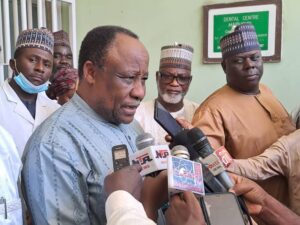
From reconstruction and infrastructure renewal to human capital development and economic recovery, the North-East Development Commission’s development framework seeks to lay the foundation for a more resilient, inclusive and prosperous region.
The journey towards lasting peace and prosperity in Nigeria’s North-East requires more than rebuilding damaged infrastructure. It demands a coordinated development strategy that addresses the underlying challenges of insecurity, displacement, unemployment, poverty and limited access to essential services. At the centre of this regional recovery effort is the North-East Development Commission (NEDC), whose development and stabilisation agenda provides a framework for rebuilding communities, restoring livelihoods and creating opportunities for sustainable growth.
Under the leadership of its Managing Director and Chief Executive Officer, Dr. Mohammed G. Alkali, the Commission has pursued a development approach that connects reconstruction with long-term economic transformation. Through the framework of the North-East Stabilisation and Development Master Plan (NESDMP), the Commission seeks to move the region beyond emergency recovery towards a future defined by stronger institutions, improved infrastructure, expanded opportunities and greater community resilience.
Describing Dr. Alkali as an architect of this development agenda reflects his leadership role in steering the Commission’s implementation efforts, coordinating development priorities and translating the broader recovery vision into practical interventions across the region.
The 11 Pillars: A Framework for Regional Transformation
The North-East’s recovery challenges are interconnected. Roads cannot deliver their full economic benefits where communities lack security, markets, electricity or access to education. Similarly, schools and healthcare facilities require functioning infrastructure, qualified personnel and sustainable support to achieve lasting results.
The NESDMP’s 11-pillar framework provides a broad structure for addressing these interconnected needs. Its underlying development logic is to coordinate reconstruction, stabilisation and socioeconomic advancement rather than treat each challenge as an isolated problem.
For Dr. Alkali and the NEDC, the central task is to ensure that development interventions respond to the priorities of affected communities while supporting the region’s transition towards sustainable prosperity.
The framework’s significance lies in its long-term orientation: rebuilding what was lost, strengthening what remains and creating new opportunities for communities whose economic and social lives have been disrupted by years of conflict.
Infrastructure: Building the Road to Prosperity
Infrastructure remains a fundamental component of regional recovery. For communities emerging from prolonged insecurity, roads are more than transport routes; they connect farmers to markets, students to schools, patients to healthcare facilities and businesses to new commercial opportunities.
The NEDC’s reported infrastructure portfolio includes road projects spanning more than 300 kilometres and the construction or rehabilitation of 50 bridges. These interventions are intended to improve connectivity, facilitate movement and support economic activity across the North-East.
Better road networks can reduce travel difficulties, improve access to essential services and strengthen links between rural communities and commercial centres. Bridges can also restore vital connections where damaged or inadequate crossings have historically restricted movement.
However, the ultimate measure of success extends beyond kilometres of roads constructed. It includes the quality and durability of the infrastructure, its accessibility to local communities and its contribution to livelihoods, trade and regional integration.
Under Dr. Alkali’s leadership, infrastructure development is therefore an important part of a wider ambition: creating the physical connections upon which a more productive and economically integrated North-East can be built.
Lighting Communities and Restoring Confidence
Access to reliable lighting is another important dimension of community recovery. The NEDC’s reported delivery of more than 100,000 lights under its Light Up the North-East initiative represents an effort to improve public-space illumination and support safer, more active communities.
Well-planned public lighting can extend productive hours, improve visibility around roads and public facilities, support evening commercial activities and enhance the usability of public spaces. Where solar technology is deployed, it can also reduce dependence on conventional electricity supplies.
The long-term value of such interventions depends on effective installation, maintenance and replacement arrangements, as well as the needs of the communities served.
Together with road infrastructure and other public amenities, lighting forms part of the broader effort to restore confidence and improve everyday living conditions throughout the region.
Education and Human Capital Development
Sustainable prosperity cannot be achieved through physical infrastructure alone. The North-East also needs educated young people, skilled workers, capable institutions and opportunities that allow its growing population to participate productively in the economy.
The Commission’s reported portfolio includes 18 mega-school projects and 49 tertiary-education projects. These investments reflect the importance of educational infrastructure in expanding access to learning and strengthening the region’s human-capital base.
Schools and tertiary institutions can contribute to recovery by providing learning environments, developing professional skills and preparing young people for employment and entrepreneurship. In communities affected by conflict, restoring educational opportunities also helps rebuild a sense of continuity and hope.
Nevertheless, the impact of educational investments must ultimately be assessed through more than completed buildings. Enrolment, attendance, teaching quality, access to learning materials, graduate outcomes and the ability of young people to secure meaningful opportunities are equally important indicators.
For the NEDC, connecting educational infrastructure with skills acquisition and employment opportunities will be essential to ensuring that the next generation becomes an active participant in the region’s reconstruction and development.
Healthcare: Investing in Healthy Citizens
A region’s prosperity is inseparable from the health and wellbeing of its people. The NESDMP therefore identifies healthy citizens as a key development priority, recognising that access to quality healthcare is essential for productive communities and sustainable economic growth.
The NEDC has expanded its healthcare interventions through investments in medical equipment and facilities. Recent reports indicate that the Commission has supported the deployment of advanced diagnostic equipment, including MRI systems, to improve access to specialist healthcare across the six states.
These interventions are intended to strengthen healthcare delivery, reduce the need for patients to travel long distances for specialised medical services and improve the capacity of regional health institutions.
For the development agenda to achieve its full potential, investments in medical technology must be accompanied by trained personnel, reliable electricity, maintenance arrangements and adequate operational funding.
Agriculture, Enterprise and Economic Empowerment
Agriculture remains a major source of livelihood across the North-East. Farmers, pastoralists, processors, traders and small-business owners all have a stake in the region’s economic recovery.
The NESDMP’s pillars of leadership in agriculture, productive entrepreneurs and flourishing trade recognise the importance of moving beyond relief interventions towards sustainable livelihoods and wealth creation.
By improving roads, supporting agricultural development and strengthening the conditions for business activity, the NEDC’s interventions seek to create an environment in which producers can access markets and entrepreneurs can expand their operations.
In July 2026, the Commission also announced a development investment package that included a proposed 50-megawatt power project and an additional ₦100 billion earmarked for roads and bridges. The broader package was reported as part of the effort to accelerate regional development.
Reliable electricity could help small businesses reduce operating costs, support agro-processing, preserve agricultural produce and encourage investment in local industries. Better transport infrastructure could similarly reduce the cost of moving goods between production centres and markets.
The challenge is to ensure that these investments translate into measurable benefits for ordinary citizens, particularly young people, women, small-scale farmers and entrepreneurs who need access to finance, skills and productive opportunities.
From Stabilisation to Sustainable Prosperity
One of the defining features of the NESDMP is its long-term horizon. The 2020–2030 plan was designed to move through overlapping phases of recovery and stabilisation, renewal, expansion and sustainable growth. It contains 11 pillars and 529 schemes, programmes and projects.
This structure acknowledges that regional transformation cannot be achieved through isolated projects or short-term interventions. It requires sustained coordination among federal, state and local governments, development institutions, the private sector, traditional leaders, civil society and local communities.
As the region advances towards the plan’s 2030 horizon, the emphasis must increasingly be on consolidating completed projects, maintaining existing infrastructure, attracting productive investment and ensuring that development gains reach underserved communities.
The emerging priorities of power supply, transport connectivity and electric mobility also point towards a broader development conversation: how the North-East can combine essential infrastructure with new technologies, technical skills and environmentally responsible growth.
Such ambitions will require careful planning, transparent procurement, reliable financing and effective monitoring to ensure that proposed projects are delivered and that their benefits are sustained.
Accountability and the Measure of Leadership
The scale of the North-East’s development needs makes accountability indispensable. Roads must remain serviceable, schools must deliver quality education, healthcare facilities must function effectively and livelihood programmes must produce tangible economic outcomes.
For Dr. Alkali and the NEDC, the enduring measure of the development agenda will be the extent to which the Commission’s interventions improve citizens’ lives across Adamawa, Bauchi, Borno, Gombe, Taraba and Yobe.
Regular reporting on project completion, expenditure, geographical distribution, maintenance and socioeconomic outcomes will help the public understand what has been achieved and where further work is required.
Equally important is community participation. Residents who use roads, attend schools, access health facilities and operate businesses are well placed to provide feedback on whether projects meet their needs. Their experiences should remain central to the assessment of development performance.
The 11-pillar framework offers an integrated roadmap, but its long-term success depends on effective implementation, institutional continuity and measurable improvements in living standards.
Conclusion: Building a Future Beyond Recovery
Dr. Mohammed G. Alkali’s leadership at the North-East Development Commission is closely associated with the implementation of a regional development framework designed to connect reconstruction with long-term prosperity.
Through the NESDMP, the Commission has established a roadmap encompassing peaceful communities, agriculture, healthcare, education, trade, entrepreneurship, infrastructure, industrialisation, environmental protection and regional connectivity.
Reported interventions in roads and bridges, public lighting, schools and tertiary institutions provide important examples of the physical and social foundations being developed. New investment proposals in power, transport and other sectors point towards the next stage of the region’s development ambitions.
Yet the ultimate objective is greater than the completion of projects. It is a North-East where farmers can reach markets, children can learn in safe and functional schools, patients can access quality healthcare, businesses can obtain reliable power, and young people can find meaningful opportunities at home.
That is the broader meaning of building the road to prosperity: transforming a development plan into lasting improvements in security, dignity, productivity and opportunity.
As the region works towards the 2030 vision, the central task remains clear—to consolidate recovery, accelerate inclusive development and ensure that the promise of prosperity becomes a lived reality for the people of the North-East.
Dr. Mohammed G. Alkali and the NEDC’s 11-pillar development agenda: Building the foundations for a connected, resilient and prosperous North-East.