
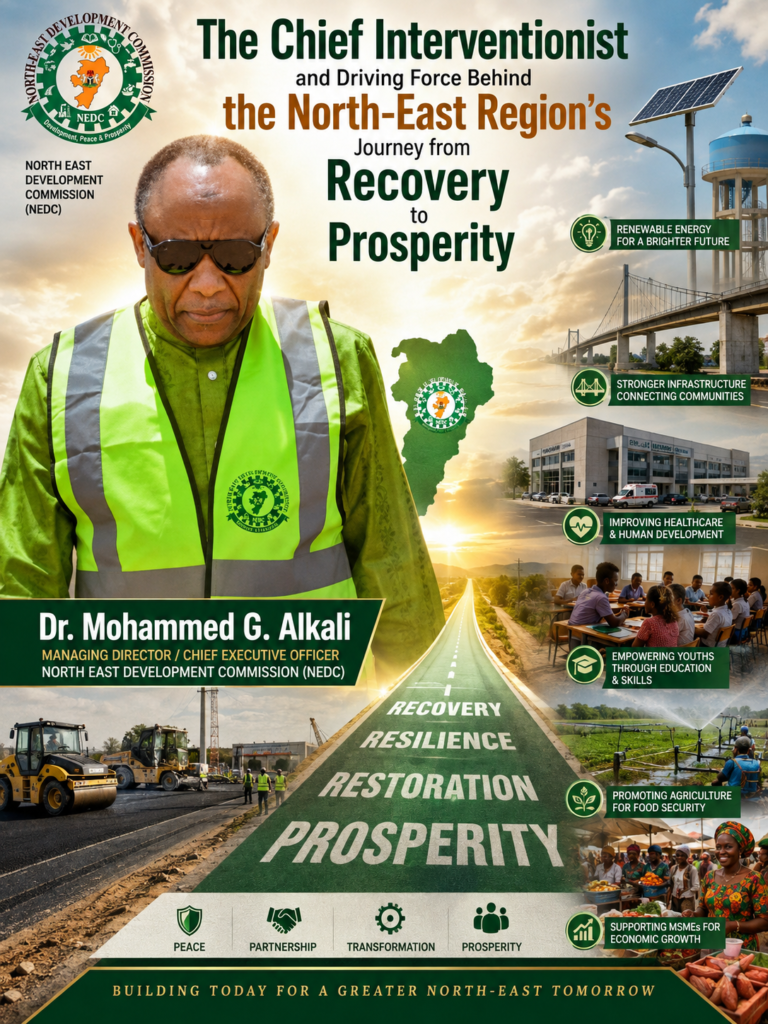
The North-East Development Commission (NEDC), under the leadership of its Managing Director and Chief Executive Officer, Dr Mohammed G. Alkali, has emerged as a key institutional driver of the transformation taking place across Nigeria’s North-East.
The Commission’s interventions are increasingly shifting the region beyond post-insurgency reconstruction and stabilisation towards sustainable economic development, resilience and prosperity.
At the centre of this transformation is the North-East Stabilisation and Development Master Plan (NESDMP) 2020–2030, a 10-year strategic framework designed to provide a coordinated roadmap for the recovery, stabilisation, renewal, expansion and sustainable growth of Adamawa, Bauchi, Borno, Gombe, Taraba and Yobe states.
The Master Plan was developed in response to the enormous developmental challenges created by years of insurgency, displacement and economic disruption, while establishing a long-term pathway for infrastructure renewal, human capital development, economic diversification and regional growth.
Under Alkali’s leadership, NEDC has increasingly aligned its projects and programmes with the broader objectives of the NESDMP, with interventions spanning infrastructure, education, healthcare, agriculture, renewable energy, entrepreneurship, trade, environmental sustainability and other critical sectors.
The Master Plan is anchored on 11 strategic pillars, which provide the foundation for the region’s transformation agenda.
- Peaceful Society
Peace and stability constitute the foundation for meaningful development.
The NEDC recognises that sustainable development cannot be achieved in communities affected by insecurity, displacement and social disruption.
Consequently, efforts to rebuild communities, restore livelihoods and infrastructure, support vulnerable populations and create economic opportunities form part of the wider stabilisation process.
The ultimate objective is to create an environment where communities can recover, rebuild and actively participate in economic development.
- Connected Region
A prosperous North-East requires effective connectivity among its communities and states.
The Connected Region pillar focuses on improving transportation and communication networks to facilitate the movement of people, agricultural produce, goods and services.
Roads, bridges and related infrastructure therefore serve not merely as construction projects but as strategic economic assets connecting communities to markets, schools, hospitals and opportunities.
- Leadership in Agriculture
Agriculture remains a major source of livelihood for millions of people across the North-East.
The Leadership in Agriculture pillar seeks to modernise agricultural production, strengthen value chains, improve food security and expand opportunities for farmers and agribusinesses.
The objective is to transform agriculture from predominantly subsistence production into commercially viable and technology-driven agribusiness capable of creating employment, generating income and stimulating regional growth.
- Healthy Citizens
A healthy population is essential to sustainable human development.
The Healthy Citizens pillar focuses on strengthening healthcare delivery, expanding access to quality medical services and addressing critical health challenges confronting communities across the region.
Investments in hospitals, specialist services, maternal and child healthcare, medical equipment and other health infrastructure are therefore central to rebuilding human capital and improving citizens’ quality of life.
- Educated Populace
Education remains one of the most powerful tools for breaking the cycle of poverty and vulnerability.
The Educated Populace pillar seeks to expand access to quality education, improve educational infrastructure and equip young people with the knowledge and skills required to participate effectively in the modern economy.
Scholarships, schools, hostels, ICT facilities, teacher development and skills-acquisition programmes complement this objective.
- Flourishing Trade
The North-East has historically occupied an important position as a commercial gateway linking Nigeria with neighbouring countries.
The Flourishing Trade pillar seeks to revitalise commerce through improved market infrastructure, stronger connectivity and an enabling environment for legitimate trade and investment.
A vibrant trading environment can stimulate economic activity, increase household incomes and strengthen the region’s position as a major commercial hub.
- Productive Entrepreneurs
Entrepreneurs and small businesses are critical to the economic future of the region.
Through the Productive Entrepreneurs pillar, the NESDMP promotes access to finance, entrepreneurship development, skills acquisition, innovation and enterprise expansion.
Empowering micro, small and medium enterprises can help young people transition from job seekers to job creators while strengthening local economies.
- Purposeful Infrastructure
Infrastructure remains one of the most visible components of the North-East’s transformation.
The Purposeful Infrastructure pillar seeks to ensure that infrastructure development responds directly to the needs of communities and the economic priorities of the region.
Roads, bridges, water systems, schools, healthcare facilities, housing and other public infrastructure provide the foundation upon which sustainable development can be built.
- Industrialisation
The NESDMP also seeks to position the North-East for greater industrial development.
The Industrialisation pillar focuses on processing the region’s agricultural and mineral resources locally, strengthening value chains and expanding manufacturing activities.
Industrialisation will help reduce dependence on the export of raw materials, create employment and generate new sources of income for households and governments.
- Memorable Experience
The transformation agenda also recognises the economic value of the North-East’s cultural, historical and tourism assets.
The Memorable Experience pillar seeks to promote tourism, culture, heritage and recreational opportunities as additional drivers of economic activity.
By projecting its cultural richness, hospitality and investment opportunities, the region can attract tourists, investors and development partners.
- Protected Environment
Environmental sustainability is fundamental to the region’s long-term prosperity.
The Protected Environment pillar addresses environmental degradation, desertification, climate-related challenges and other ecological threats.
This is particularly important in the North-East, where agriculture and livelihoods depend heavily on natural resources.
From Recovery to Prosperity
The significance of the NESDMP lies in its effort to take the North-East beyond emergency response and reconstruction towards a coordinated, sustainable development model.
The roadmap is structured around four interconnected phases: Recovery and Stabilisation, Renewal, Expansion and Sustainable Growth.
The framework therefore provides a transition from rebuilding communities and infrastructure damaged by conflict to creating new economic opportunities and developing a more resilient regional economy.
NEDC’s statutory responsibilities similarly extend beyond reconstruction to the broader development of the regional economy, making the Commission a crucial institutional vehicle for implementing the region’s long-term transformation agenda.
Alkali’s Role in the Transformation
As Managing Director and Chief Executive Officer, Dr Mohammed G. Alkali has become closely associated with the implementation of NEDC’s development agenda.
His leadership has emphasised the importance of viewing the NESDMP as an integrated development framework rather than treating individual interventions as isolated projects.
Under this approach, infrastructure development is linked with human capital development, economic empowerment, agriculture, healthcare, education, environmental sustainability and peace-building.
The development of the NESDMP itself involved consultations and baseline assessments with stakeholders across the region, including communities, development partners, civil society organisations, the private sector, federal agencies and security institutions.
This broad-based approach reflects the reality that the transformation of the North-East requires collective action by governments, communities, development partners and the private sector.
A New Development Narrative
For many years, the North-East was predominantly associated with insecurity, poverty, displacement and humanitarian crises.
Today, an emerging development narrative is increasingly centred on reconstruction, resilience, investment, innovation and economic opportunity.
NEDC’s interventions under the NESDMP are therefore part of a broader effort to change the socioeconomic fortunes of the region and create an environment where citizens can live, learn, work and prosper.
The transformation agenda goes beyond the construction of roads, schools and hospitals. It seeks to create an interconnected regional economy where citizens have access to quality education and healthcare, farmers have access to markets, entrepreneurs can obtain opportunities and financing, communities benefit from essential infrastructure, and investors find a more conducive environment for business.
Conclusion
Dr Mohammed G. Alkali’s leadership of NEDC comes at a defining period in the development history of the North-East.
With the 11 pillars of the NESDMP providing the strategic foundation, the Commission faces the critical task of sustaining the region’s transition from emergency recovery to long-term economic transformation.
The journey from recovery to prosperity will require continuity, accountability, collaboration among governments and development partners, increased private-sector participation and sustained investment in the people of the North-East.
Ultimately, the success of the transformation agenda will not be measured solely by the number of projects executed, but by the extent to which those interventions produce peaceful communities, stronger human capital, productive economies, improved livelihoods and sustainable prosperity.
For the North-East, the NESDMP provides the roadmap, while NEDC remains one of the principal institutional vehicles driving the region’s journey from recovery to prosperity.


