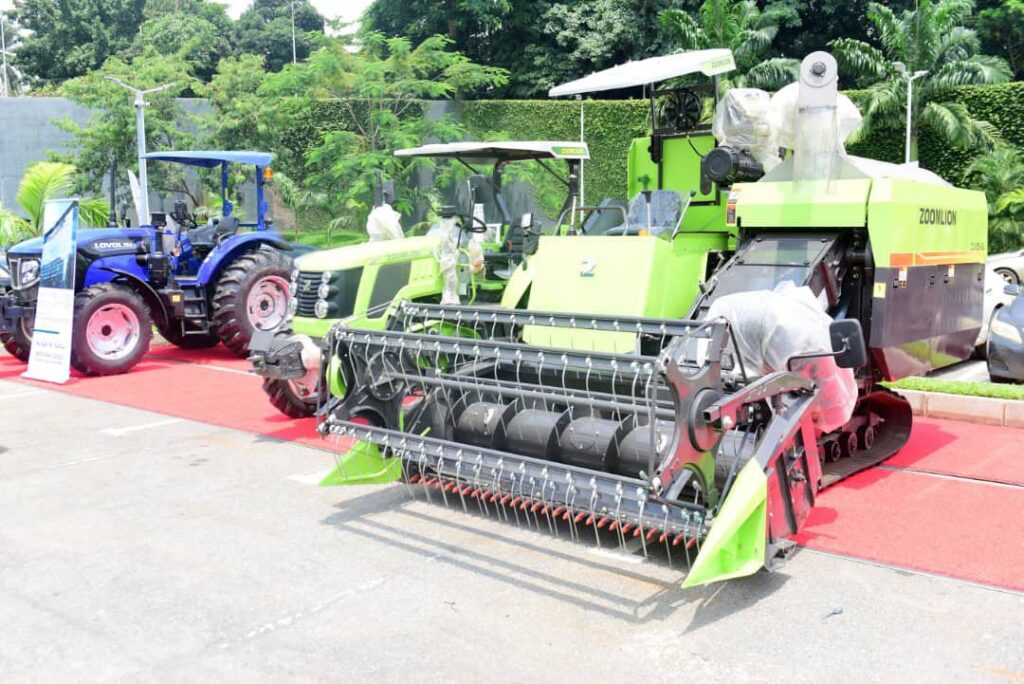
Borno State Governor, Prof. Babagana Umara Zulum, has called for a fundamental transformation of Nigeria’s approach to agricultural mechanisation, urging the country to move beyond the conventional model of purchasing and distributing tractors to a modern system that provides farmers with reliable, technology-driven agricultural services.
Zulum made the call on Wednesday in Abuja while speaking at a High-Level National Policy Dialogue on Agricultural Mechanisation, organised by the Federal Ministry of Agriculture and Food Security.
The Governor said Nigeria’s agricultural transformation should not be measured by the number of tractors acquired or distributed, but by the extent to which farmers gain timely and affordable access to mechanised services that increase productivity, reduce production costs and improve food security.
According to him, the country faces a combination of low agricultural productivity, limited adoption of modern technology, inadequate investment, weak value chains and insufficient infrastructure, all of which continue to constrain the sector’s contribution to economic development.
From Tractor Ownership to Agricultural Services
Zulum advocated a shift from tractor ownership to a service-based agricultural mechanisation model, under which farmers can access machinery and modern technologies when and where they are needed without necessarily having to own expensive equipment.
He said such an approach would enable farmers to access services for land preparation, planting, precision agriculture, irrigation, harvesting and other stages of the production cycle.
The Governor explained that a service-based model could also improve the utilisation of agricultural machinery, reduce maintenance challenges and make mechanisation more accessible to smallholder farmers, who constitute a significant part of Nigeria’s agricultural workforce.
He stressed that mechanisation must be integrated with digital technology, irrigation, renewable energy, storage, processing and market access to achieve meaningful and sustainable agricultural transformation.
Borno’s Agriculture-Led Recovery
Zulum said agricultural development remains central to Borno State’s efforts to rebuild livelihoods and restore communities affected by insecurity and displacement.
He explained that his administration’s investments in agriculture are designed not only to increase food production but also to create economic opportunities for rural communities, strengthen household incomes and support the recovery of communities whose livelihoods have been disrupted.
The Governor noted that agriculture has the potential to serve as a major driver of reconstruction, employment creation and economic recovery when supported with appropriate infrastructure, technology, financing and market linkages.
Four-Pillar Approach to Agricultural Transformation
Zulum outlined a four-pronged approach that he said should guide Nigeria’s agricultural mechanisation strategy.
The first is mechanising agriculture to increase productivity, reduce human drudgery and improve the efficiency of farm operations.
The second is digitalising agriculture through the use of modern technologies to improve precision, data collection, decision-making, intelligence and overall efficiency across the agricultural value chain.
The third is regenerating agricultural resources to ensure that land, water and other natural resources are managed sustainably for present and future generations.
The fourth is investing in infrastructure, technology and enterprises capable of driving long-term transformation across production, processing, storage, transportation and marketing.
He argued that these components must work together if Nigeria is to move from subsistence-oriented agriculture towards a competitive and commercially viable agricultural economy.
Private Sector Investment Critical
The Governor also called for stronger private-sector participation and innovative financing mechanisms to support the development of Nigeria’s agricultural machinery ecosystem.
He identified local manufacturing and assembly of agricultural equipment, irrigation systems, renewable energy, storage facilities, agro-processing and value addition as areas requiring increased investment.
According to him, greater support should also be directed towards youth- and women-led agricultural enterprises, given their potential to create jobs and expand participation in the agricultural economy.
Zulum stressed that sustainable agricultural mechanisation requires more than government procurement. It requires an ecosystem in which manufacturers, financial institutions, technology companies, farmers, processors, investors and government agencies work together.
Building the Agriculture of Tomorrow
The Governor urged policymakers to avoid simply reproducing outdated agricultural practices and instead develop a system capable of responding to emerging economic, technological and environmental challenges.
“Nigeria must not simply recreate the agriculture of yesterday, but build the agriculture of tomorrow,” he said, stressing the need for an agricultural sector that is modern, smart, climate-resilient, productive and inclusive.
He said the ultimate objective should be to establish an agricultural economy capable of feeding Nigeria’s growing population, competing effectively in international markets, creating sustainable employment and improving living standards in rural communities.
A successful agricultural transformation, he added, would also strengthen national food security, expand opportunities for young Nigerians and stimulate economic activity across rural areas.
Zulum’s Delegation
The Governor was accompanied to the policy dialogue by the member of the House of Representatives, Engr. Bukar Talba; Commissioner for Local Government and Emirates Affairs, Sugun Mai Mele; Chief Executive Officer and Managing Director of the Borno Investment Company, Mohammed Bukar Umar; and Permanent Secretary, Government House, Mustapha Ali Busiguma.
The policy dialogue provided an opportunity for stakeholders to examine practical strategies for expanding agricultural mechanisation and creating a more productive, technology-enabled and investment-driven agricultural sector in Nigeria.
For Nigeria to achieve sustainable food security, the discussions underscored the importance of moving beyond the acquisition of agricultural machinery towards building a complete mechanisation ecosystem—one that gives farmers dependable access to equipment, technology, finance, infrastructure and markets.
Zulum’s proposal therefore places agricultural mechanisation within a broader economic transformation agenda, where technology and investment are deployed not merely to put more machines on farms, but to enable farmers to produce more efficiently, earn better incomes and contribute meaningfully to Nigeria’s economic growth.